
Send your input to Class Scribe - Denny Coll at dc65scribe@comcast.net
ABE WORKING HARD TO REPRESENT S & D WITH USMA WRESTLING
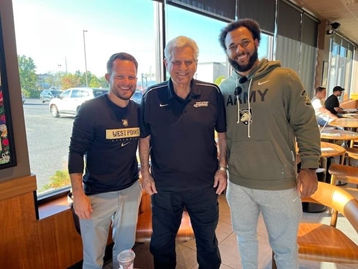
Fred Smith
Freddie called Chuck Shaw on his Birthday.
- Chuck has been developing a new hobby/business
- Please check out the web site: SHAW'S CAROLINA GOURMET; Nice photo of Chuck on the web site
Fred observes:
- Most of us are pretty much retired
- Not Chuck, he is growing a new business
- This is not an advertisement, just a salute to Chuck's long list of experiences
- 150-pound football captain, Navy Star, All East
- Member of the Jaguars Band at USMA
- Air Force Service
- Banker including Paris assignment
- Wine maker and his famous Charles Shaw Merlot, which revolutionized the nascent Merlot industry in America
AND STILL MORE FROM FRED SMITH
Ed. Note - this is pretty impressive, S & D! We should all Stand TALL! Thanx for bring this to our attention Fred!
This from AOG officer to Fred Smith on 10/3/25:
Your Class has contributed to the:
- Southeast Asia Memorial
- The West Point Preparatory School Program Endowment
- Thayer Walk
- The Crew team
- Army-Navy videos
Your Class also created or donated to:
- The Class of 1965 Arvin Gymnasium Entrance
- The Center for Oral History
- Given 100 copies of the book "Every Army Man is with You" to the Army Football team
- Supported the 50-year affiliate program with the Class of 2015
For your 50th reunion gift you generously supported:
- The Center for Oral History Endowment
- The Long Gray Line Endowment
- The Bob Jones ’65 Fallen Graduates Memorial Scholarship Endowment
- The Class of 1965 Maintenance Endowment
- The COL Harry Dermody ’65 Summer Leaders Experience Scholar Endowment
- The COL Harry Dermody ’54 Cadet Public Relations Council Endowment
And finally, this year for your 60th reunion and class gift you:
- Gave to the Superintendent’s Annual Fund
- The Dean’s Fund
- The Commandant’s Fund
- The Long Gray Line Fund
- The Athletics Fund
- The Center for Oral History Endowment
CLASS of 1965 – SOUTHEASTERN PA / NJ LUNCH GROUP - JOE BARKLEY
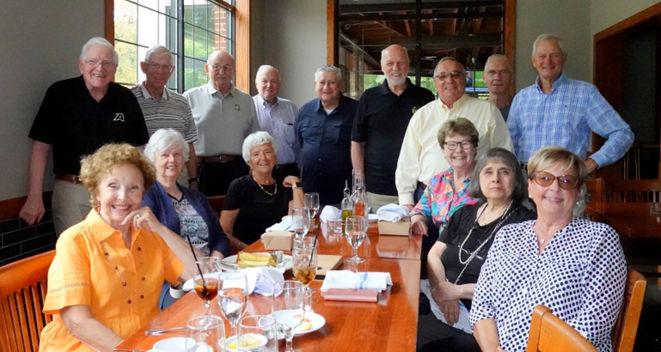
Betsy Reed, Mary Ellen Smith, Francis Reisner,
and Ingrid Locurcio. Standing, L-R; Chuck McCloskey,
Howie Reed, Joe Barkley, Roy Garms, Dan Donaghy,
Rick Kuzman, Ralph Locurico, Bill Reisner, and Fred Smith.
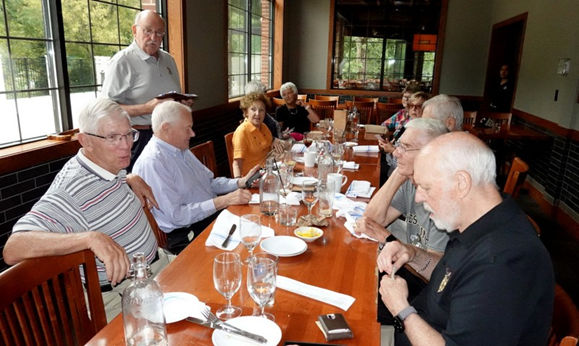
Fred Smith and Ralph Locurico volunteered to host the next lunch on Wednesday, January 21, 2026, out on the western side of Philadelphia.
BOB BRADLEY REMINISCES
ON BOB JONES: Bob was released from the Hanoi Hilton after 5 years (he said it was a lot like Plebe year). He and the other POWs were flown to the Philippines for medical check-ups and debriefings. They were basically locked up in a hotel so after 2 days Bob said, "This is b.s., let's blow this place." He and a fellow POW snuck out, flagged down a cab and went to the nearby post Officer's Club.
Sitting at the bar, Bob noticed a nearby table of Army nurses who had just gotten off duty so Bob & friend joined them. Bob noticed one of the nurses was wearing a unique bracelet and asked, "What's that?" She explained it was a POW bracelet with a POW's name that she would continue wearing until the POW was released from the Hanoi Hilton. Bob asked, "Is my name on your bracelet?" She said, "What do mean?" Bob said he had just been released from the Hanoi Hilton 2 days ago, so the nurse said, "Come with me."
She took him back to her Unit and they celebrated his freedom with her compatriots.
MORE FROM BRADLEY - I didn't know John (Seymour) at WP because he was one of the star jocks but I got to know him here in San Diego when he and Denny Lewis bought a commercial building in San Diego (another story when the water department mistakenly hooked up the potable water pipe to the building fresh water input pipe).
John had great stories: All us Plebes were assembled in the auditorium when an officer commanded "on your feet!" He then proceeded to say, "If you were h.s. valedictorian, sit down. If you were h.s. solitarian, sit down. If you were in the top 5% of your h.s. academically, sit down. If you were in the top 10% of your h.s. class academically, sit down. If you were in the top. "
Finally, there were about 40 plebes left standing and the officer said, "Gentleman, I'd like to introduce the 1965 plebe football team."
Seymour and another plebe football star (Stichweh?) were turned out in Portuguese. A captain from the language department came into the room to administer the turn out exam. He asked, "How do you say 'cat' in Portuguese?" One of the turn outs mumbled something in Portuguese. The captain said, "Close enough, now get xxx outta here and score some touchdowns!"
BARRIE ZAIS
FROM FAYE HAYES ON BOB RADCLIFF
I am forwarding this email to let you know that Bob’s WP Class of 65 ring will be included in the Ring Melt coming up in January. I will attend the ceremony and my sister, Maye Hayes Jepson will accompany me. Bob was very impressed with the Ring Melt Program and had expressed his wish to have his ring go into the next Melt after his passing. In January 2025, I was not ready to give up his Class ring but am now ready to honor his wishes.
I would also like to take this opportunity to let you know that I am doing well. I miss my beloved, Bob everyday but my own health issues have helped to take my mind off his absence, somewhat. I am currently on a daily chemo pill and tolerating the side affects quite well. I will continue to be monitored closely by my oncologist and am expecting no complications/recurrence going forward.
All the Best, Faye
UPDATE ON BOB'S FUNERAL AT ARLINGTON
(Ed. Note - Faye had asked for help regarding the scheduling of Bob's funeral due to an oversight by her funeral director; here is my response)
Faye, I was able to get advice and counsel from a very high level. Here is the jist of my conversations:
You will have to wait for Bob’s name to appear on the schedule. There is no process to move him forward based on an undertaker’s negligence.
Our Classmate Mike Viani’s funeral at Arlington was a few days ago. According to Mike’s eldest son, wait time for burial was five months. Mike, a retired 06, had a casket burial with full honors, but without a chapel service.
Every variation has a different wait time. Various options include: casket or cremated remains, in ground or columbarium, full honors or something less, Admin Building or chapel. For reasons unknown, cremated remains take longer than casket remains.
Bob’s status is that his service is not yet scheduled. The establishment wait time for full honors, chapel service and cremated remains is 15 months from the time of request and issuance of a number.
Arlington National handles about 30 funerals a day. It’s a true zero-sum situation with a favor to one authorized honoree becomes a disadvantage to another.
Regards, Denny
UPDATE ON LARRY BENNETT FROM MITCH BONNETT
I just got off the phone with Jean Bennett, Larry’s wife. Larry’s birthday was yesterday, and though I wasn’t able to call then, I called this afternoon to wish him a happy birthday.
Jean called me back and let me know Larry is in the hospital. She said he’s had major health issues for several years now, and it doesn’t sound like he’s doing well at all.
Jean and I had a good conversation. She mentioned they had lost a daughter who passed away in her 50’s. Their son served as an Air Force officer, and that son has a child who also attended an Academy although I didn’t catch whether it was West Point or the Air Force Academy. It was that son who came back yesterday for Larry’s birthday, only to find him in the hospital.
Jean was very open to having classmates know what’s happening. She said they’ve tried to stay in touch with several of our classmates and felt it would be good for others to hear about Larry’s situation.
Larry is in Gainesville, Virginia.
YOUR SCRIBE AND DEPUTY SCRIBE ABROAD AND AFLOAT
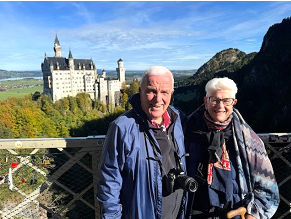

Breakfast was normal, Lunch and Dinner were not: at EACH of these meals, we were treated to 5 course meals, 2 - 4 premier wines (Red & Whites, all 1er or Gran Crus and each one different) all of which were introduced, with a flourish and the appropriate provenance, by either the Chef, the Captain or one of the Hostesses.

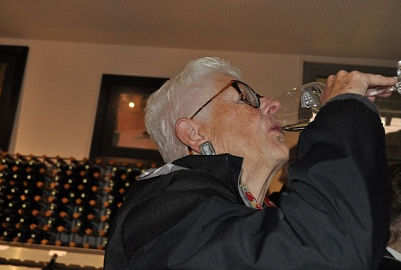
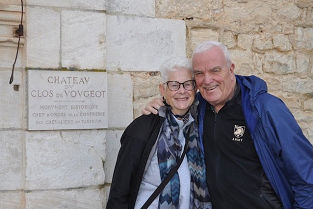
And of course, in Munchenstadt, we had to visit the ... Ratskeller Munchen (see pic of Cathy & beer glass below). If you thought I was going to say Hofbrauhaus, my last visit to same many years ago, was really disappointing - open-aired Cocaine sales in the men's room.
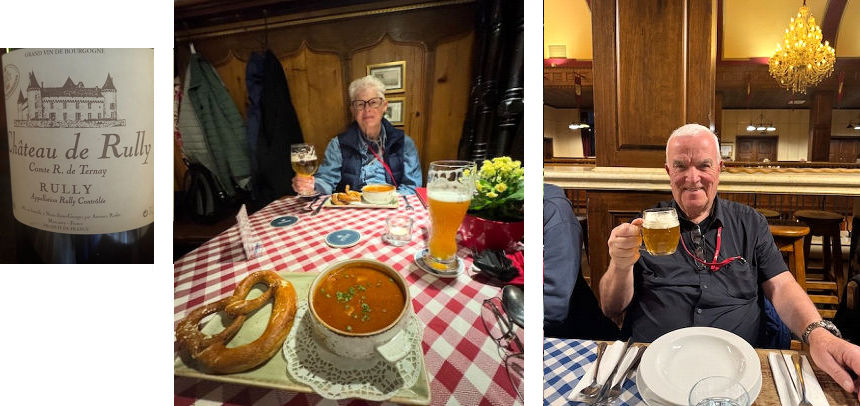
Lessons learned: if you do something like this trip and use Viking, have them make your air travel arrangements also; getting thru European airports, Customs, etc. was not as easy at our age as it was when I lived in Germany in my 20's. Viking made it all a breeze; they handled everything! We also used a fantastic travel agent who made sure all of the myriad things that had to be arranged for a 21-day trip, were arranged.
Back home only 2 pounds heavier; could not believe it. A wonderful experience.
THREE AMIGOS TRIUMPHANT RETURN TO WEST POINT
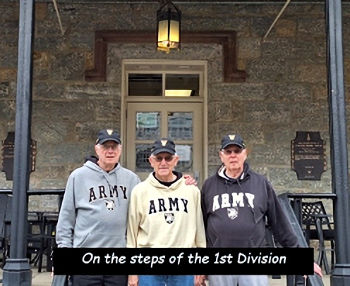
Three Amigos, Ben Whitehouse, Paul Singelyn, and Jay Vaughn, after many earlier adventures, returned to West Point together for the first time since graduation. Three highlights of the trip were watching a parade that included the Official West Point March, watching the Army football team spank UNC Charlotte, and returning to the very room their friendship began 63 years ago, that being Room 204 of the 1st Division.
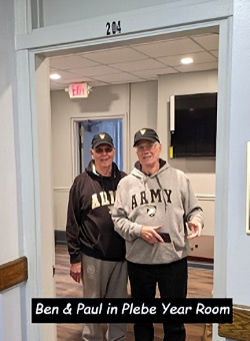
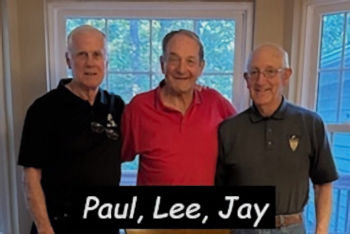
Theme of this adventure's was the goose. A suicidal goose chose Paul's Subaru windshield to end its life just east of Knoxville, making the drive from Nashville to Raleigh a challenge. USAA and a very helpful Safelite lady named Henrietta helped us to replace the windshield on short notice in Raleigh (Ben's home) and we were on our way north with Ben now onboard. Hearing the Thumper march at the parade brought goosebumps, as did being at Michie Stadium and standing in the actual room where we first met. Finally, it should be noted that our E-1 Tactical Officer when we were Plebes was Major “Goose” Gosling.

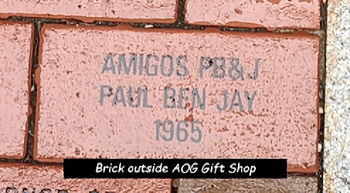
1. Found the Amigo brick out side the AOG gift shop.
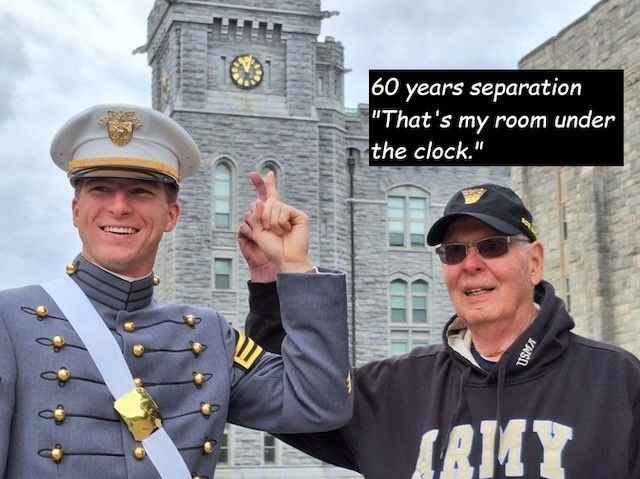
2. Ben was pointing out his First Class Year room under the clock in East Barracks when a cadet walking by escorting hisfamily said, “That's my room now!!”
3. A lady watching us get the Trophy Point pic said, “How cute, black, gold, and gray, just like the color of my hair.”
4. After the game we ran into classmate, John Salomone and his wife Mary Kay for a fun but too brief conversation.
5. Wearing the Army sweatshirts resulted in a couple of free meals from anonymous benefactors who were either thanking us for our Army service or justtaking care of three pathetic but adorable old men.
6. Revisiting Gettysburg battlefield.
Finally, Paul and Jay stopped to visit Lee and Suzanne Atchley in Chattanooga on our way back to Nashville. Suzanne fed us and Lee humored us. This visit was cut short when Jay realized that his flight home from Nashville the next day was at 5:00am and not 5:00pm as he thought. The middle of the night scramble to catch the flight was a classic ending to another typical Three Amigos adventure.
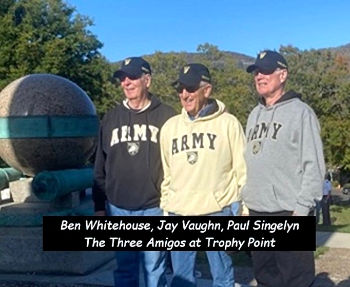
FROM BOB FRANK

Unexpectedly, Jeanne passed away on 20 October. While playing bridge with Jim and the McCloskeys, Jeanne experienced a severe headache, causing an immediate halt in the game and a trip to the emergency room. Shortly after arriving, Jeanne’s life expired while Jim was holding her hand.
Jim and his daughter Amy set about arranging for Jeanne’s funeral at the Church of St. Anne in Garden City, NY. Jeanne had grown up in that church; the Harmons were married there; and she and Jim were congregants there when they returned to Garden City many years ago.
He was in third grade when she entered first grade."In a poignant remembrance, one of the two priests who conducted the funeral mass recalled first meeting Jeanne in 1951 when she was in the first grade at St. Anne's and he the third."
Rallying to support Jim and to honor Jeanne was a sizable Class of ’65 contingent: Larry Neal, Ross and Myrita Wollen, Ray and Linda Hawkins, Bob and Jeanette Scully, Tom Barron and Chris Hjorth, Chuck and Rosemary McCluskey, Bob and Mary Frank, and Paul Kantrowich.
After the church service and graveside prayers, the Harmon family and guests gathered at the West End Café for a repast luncheon, at which recollections of Jeanne were shared. It was clear how deep was Jeanne’s impact on those who were facing great stress in their life. Comments made clear that Jeanne led a very consequential life, such as helping establishing and directing local Ronald McDonald houses. Jeanne’s ability to overcome barriers often lessened the strain on families facing emotional distress. She truly lived her life for others.
FROM MINNEAPOLIS AND KEN YOSHITANI

Among many items reminisced, we enjoyed the group photo from the Ranger School (courtesy of Dave Bodde). We identified all of us, except Ken Hjelm who who joined the AF. Izumi and I committed to visit the Wolffs either in MD or FL. We eight will gather again next spring when Jim and Julie return from FL.
Go Army and Go Vikings!
CADETS, USMA
I thought that I would update everyone on some Cadet news; I'll do this whenever I see something interesting. I'll also try for an annual, May update about our Cadet progeny at USMA and their activities.
Cadet Larry Picket '28 -If you have not seen the video clip of Yearling (and Army football team safety) Larry Pickett, Jr. acceptance speech at the Thursday night Fox News Patriot Awards Ceremony, take a look. Very humble and impressive young man and a great credit to our Alma Mater!
2LT Bryson Daily '25 - Our Special Guest at the 60th, Bryson Daily (the National Collegiate Quarterback of the Year) is engaged to his long-time high school sweetheart, Conley. Tyson is the Grad Student QB Coach at the Prep School. I sent a Congrats email to Bryson on behalf of S & D.
Ed. Notes: * That's it for now; several of you have promised me updates; I hope you will come through. Without your input, these Blasts are pretty bland! * Great win over the Zoomies; let's hope for same result against the Squids!
FROM JAY VAUGHN:

Our most interesting discussion was about Doug Davis and our very special guest, Bonnie Abney, now our very first honorary Grayhog Geezer sister. In 1966, Bonnie was packed to fly to Hawaii to marry Doug when he was KIA. She later traveled to Bisbee, AZ to help Doug's mother and family with funeral arrangements.
A purpose of this latest visit to Arizona, besides attending the wedding of Doug's niece and visiting Doug's gravesite, was to find and revisit the rail siding where she and the funeral director met the train bearing Doug's coffin. This has been a challenge over the years since all of the rail lines, station houses, and other evidence of railroads were removed and have been gone for decades.
Incidentally, Doug's and Bonnie's love story is contained in the J.A. Jance novel, "Second Watch." We're happy to say that Bonnie succeeded in her quest to find that elusive rail siding.
FROM LARRY NEAL - THE PHOENIX GET-TOGETHER
Once Upon a Time in Phoenix

Fred and Maralee Laughlin hosted a micro-reunion in Phoenix, beginning with a wonderful dinner in their lovely home on Sunday, November 2nd.
Following cocktails and catching up with one another, we enjoyed a fine dinner prepared by chefs JD and Margaret. Class president Jim Harvey updated us on Class affairs. Jim and June were also helpful arranging hotel accommodation for the group.
The Sonoran foothills behind Fred and Maralee’s home accented the perfect, picturesque venue for our gathering. On Monday, ten of us golfed on the Ironwood course of the Anthem Country Club. Non-golfers explored the many attractions in the surrounding areas on their own.

|

|


Wednesday was our final day, with six stalwarts (Tom, John, Roxy, Larry, Fred, Bob) playing golf at Dove Valley Ranch and the remaining attendees relaxing or enjoying area attractions. It was a truly great and memorable event. The event was a joint effort of Fred, John, and Larry, with much support from Maralee, Roxy, and Ruth. Many thanks to all.
 |
 |
 |
FROM JENNY SCHOLL CASSITY
We reported earlier of the passing of Wayne Scholl's widow, Susie. Thanx to Jay Stewart, I was able to reach out to their daughter Jenny (who I haven't seen in over 25 years), who like her Mother and brother Brian, live in Southern CA. Jenny reports that they may have a small Memorial Service in CA but following her Mom's wishes, will have the main Memorial Service sometime in the Spring at the same Church near Port Washington, Wisconsin where we held the memorial after Wayne's tragic passing. She will get the details to me when everything is locked in.
Ed. Note: We have received a ton of input from S & D, so there will be a November #3 Blast in a few days. Thanx to you all for keeping your Scribe busy!
FROM EMORY PYLANT:
Sept driving trip to South Dakota including visit with Bob & Jean Stowell

They weren't able to join the hunt this year due to rather important family commitments on both sides of our brief stop. It occurred to me that we paused some intensive preparations that they were helping make for a granddaughter's upcoming wedding. Nevertheless, they served one of the best meals I can remember! Home grown vegetables, local 60 day dry aged steaks that Bob grilled in a light rain, and fabulous strawberry pie.

The hunt was the earliest we've ever attempted due to trying to find dates that most of our group could make this year. Weather was warm with temperatures up to the mid 70s, and that's a contrast to freezing mornings and mid 40 highs we usually expect. The group is now mostly retirees and while getting pheasants is still a component, the driving factor has clearly become the opportunity to reconnect with friends in an enjoyable setting.
The photo of part of the group includes both ladies this year (we've had as many as five including Jean a couple of times). Johanna on the right in a blue shirt and Emory far right.
S&D '65 Emory and Johanna Pylant
FROM: KEN YOSHITANI

Attached is the photo. From left, Jim Stephenson, Julie and Jim McEliece, Phyllis and Bob Wolff, and Izumi and Ken Yoshitani. Among many items reminisced, we enjoyed the group photo from the Ranger School (courtesy of Dave Bodde). We identified all of us, except Ken Hjelm who joined the AF.
Izumi and I committed to visit the Wolffs either in MD or FL. We eight will gather again next spring when Jim and Julie return from FL. Go Army and Go Vikings!
FROM FRED LAUGHLIN – FOLLOW UP TO PHOENIX GATHERING
Denny: As you know, we had a fun gathering of classmates and wives in Phoenix last month. On the last of the four days together, we assembled for a dinner at the local PF Chang’s. On the way to dinner, Jim Murphy tripped and fractured his hip. What followed is recounted in the attached. It’s a simple story about how the word "classmate" has changed for us since our cadet days. Jim Murphy has agreed to my sharing it, but for fear of his disapproval, I have not sought Bob Harter's blessing.
Beat Navy! Fredric Laughlin
A CLASSMATE
November 2025: On the last day of the four-day gathering of classmates in Phoenix, Jim Murphy and Bob Harter were walking from their hotel to a nearby PF Chang’s to attend a dinner with eight other classmates and their wives. Catching his foot on a curb, Jim fell to the pavement. Despite his paratrooper’s instinct to “hit-shift-and-rotate,” he suffered a fractured hip, a diagnosis confirmed an hour later in the emergency room.
Although both he and Bob had flights back to DC the next day, it was clear Jim needed some time to rest his hip. Bob took care of rescheduling their flights, extending the rental car, and rebooking their rooms at the hotel. Three days later, they were on a flight back to DC.
At DCA, Bob wheeled Jim to the baggage carousel and recruited a handler to help with the bags. The handler entered the scrum of people pushing for their bags, loaded five of them on a cart, hastened to the taxi queue, and deposited them in the trunk, while Bob helped Jim into the taxi.
It was a short ride to Jim’s house in Alexandria, where Donna, his next-door neighbor who had been alerted to Jim’s situation, was waiting for them. She helped unload the five bags and, leaving Bob’s two bags outside the front door, brought the other three inside. Bob followed with Jim in his wheelchair. Once inside, Jim looked at the three bags and recognized two as his. Was the third bag yours, Bob? Nope. The mystery bag had no tag or identification. Now what?
Bob was decisive; he would go back to the airport. Donna joined him to help with the logistics. At the airport, they hastened to baggage claim, where a tall man was standing next to the counter talking to the attendant. He turned, looked back at Bob, Donna, and the bag he had given up for lost. "That’s it!!!," he exclaimed. Rather than being angry at the misappropriated bag, he was relieved to get it back and thanked Bob and Donna for their quick response.
Epilogue: When we were at the academy, the word “classmate” was often used as a verb in a pejorative sense, as in my newly shined shoes were “classmated.” Since graduating, we have stories of guys like Bob Harter who have changed the meaning of the word. From the time Jim experienced his fall to the return of the “fifth” bag, Bob was prepared to skip a fun dinner with his classmates, get Jim to the hospital, rebook hotel rooms, reschedule flights, extend rental car arrangements, ensure that Jim had care waiting for him in Alexandria, and finally, return the mystery bag to its rightful owner.
Bob never gave a second thought to any of his actions. He also does not seek to be or need to be thanked for them. He was merely demonstrating what the word “classmate” means to us today.
SPEAKING OF CLASSMATES:
Cathy and I were in D.C. for the Thanksgiving Week with eldest son Brian and his family. We were also looking at some retirement sites around D.C. After visiting Vinson Hall, we decided to have Lunch at the local family joint in McLean and as we were eating, in walked Tom & June Fergusson, she with a copy of the Wall Street Journal (in her native language, I might add); great seeing them again. While walking thru Vinson Hall, we passed the apartment of Peter Linn; he and Susan were apparently out of town, so I left them a voicemail. We also looked at Falcons Landing near Sterling; lots of WPers there, but no S & D!
FROM JIM TILLMAN - NEED A TENTATIVE HEAD COUNT FOR LARRY STRASSNER MEMORIAL
Denny, Pat Strassner called to say they are starting to plan a memorial for Larry. It will be held at a close friend's home in Severna Park, Maryland on one of the first two weekends in June 2026. Pat asked for suggestions for charitable organizations to list in the memorial announcement. We thought the West Point Lacrosse Foundation or Class of 1965 Fund would be good.
Pat also wondered how many classmates or West Point friends might attend, even if a “Maybe” at this point!
Thanks, Jim Tillman (Strassner ’65 P.O.C.) 410-821-8162
FROM JOHN HIGLEY – INTERESTING INFO ON OUR ROCKBOUND HIGHLAND HOME
History of the Constitution Island Chain across the Hudson River
Constitution Island, opposite West Point on the Hudson River, played a central role in a system of river obstructions and forts designed to block British warships during the American Revolution. The famous “Great Chain” that stretched from West Point to Constitution Island was the culmination of several earlier attempts to control the Hudson with chains and underwater obstacles.
https://www.perplexity.ai/search/history-of-constitution-island-DhxtjXRuRAiPQnn0ivcEcQ#0
Early strategic importance: From the start of the war, American leaders saw the Hudson River as a possible “divide” between New England and the other colonies, so they focused on key narrows and bends, including the sharp S‑curve at what was then called Martelaer’s Rock, later Constitution Island. Fortification of the island as “Fort Constitution” began in 1775 as part of a broader plan to block British movement up the river.
First chain and its failure: Before the chain at Constitution Island, Colonials had stretched a barrier from Fort Montgomery to Anthony’s Nose farther downriver, along with other obstacles like chevaux‑de‑frise near Manhattan and north of West Point. In October 1777 British forces outflanked and captured Forts Montgomery and Clinton by land, dismantled that earlier chain, and then sailed upriver to raid as far as Kingston, showing that the first chain system had not secured the Highlands.
Creation of the Great Chain After these losses, American planners shifted focus upriver to West Point and Constitution Island, deciding in early 1778 that this bend and narrowing of the river was ideal for a stronger obstruction. Under engineer Captain Thomas Machin, an enormous iron chain—its links weighing roughly 90–100 pounds each—was forged in a Hudson Valley ironworks and completed in under three months, a notable industrial achievement for the time.
Deployment across the Hudson On April 30, 1778, the completed chain was floated into place on log rafts from West Point to Constitution Island, then anchored in massive timber cribs filled with stone on each shore. A secondary boom of logs, set slightly downstream, was added to absorb the impact of any ship that tried to ram the chain, while shore batteries on both sides of the river covered the barrier with cannon fire.
Operational history and legacy The Great Chain remained in seasonal use from 1778 until it was last taken out of the river in the fall of 1782, after which it was no longer re‑installed as American victory appeared likely. Although British warships never attempted to force the chain directly, its presence—combined with the guns of West Point and Constitution Island—helped deter upriver operations and protect the upper Hudson Valley, and surviving links displayed at West Point today serve as physical reminders of that defensive system.
How did the chain stop British warships during the Revolutionary War? The Hudson River “Great Chain” worked mainly as a physical barrier and a psychological deterrent, integrated with shore batteries, rather than as a stand‑alone ship destroyer. It was designed so any British warship trying to pass West Point would have to slow, be trapped, and come under heavy American cannon fire.
Physical barrier and river geometry? The chain was stretched at a sharp S‑bend in the Hudson where the current, shoals, and narrow channel already forced ships to reduce speed and maneuver carefully. At that point, the heavy iron links, floated on large timber rafts and anchored to massive shore cribs, created a rigid obstruction across the navigable channel that a sailing warship could not easily break at low speed.
Combined with a log boom Just downstream of the main chain, Americans floated a secondary wooden boom, like a huge ladder of logs, which would take the first impact of any ship attempting a ramming run. This upstream–downstream pairing meant a vessel would lose momentum on the boom and then meet the chain itself, making it very difficult to gather enough force to smash through.
Covered by fort guns Powerful artillery batteries at West Point and on Constitution Island were positioned to fire directly onto any ship that approached or became entangled in the barrier. The basic idea was not simply to halt a ship but to slow or stop it long enough that concentrated cannon and mortar fire from both banks could heavily damage or sink it.
Psychological and strategic deterrent Earlier, the British had bypassed a weaker chain farther downriver by landing troops, taking the forts, and dismantling the barrier, so American engineers built the West Point position to be more defensible from land attack as well. In practice, the Royal Navy never tried to run the Great Chain—despite Benedict Arnold telling them a heavily loaded ship might break it—because the combined risk of grounding, entanglement, and devastating cross‑river fire made the attempt strategically unattractive.
Earlier chain bypassed by land assault British forces did successfully bypass an earlier, weaker chain stretched between Fort Montgomery and Anthony’s Nose in October 1777. They landed troops upstream, captured the forts by land attack, dismantled the chain, and proceeded upriver to raid Kingston, exposing the vulnerability of riverside defenses to infantry assaults.
No direct naval challenges at West Point After the Great Chain's deployment in 1778, the Royal Navy made no recorded efforts to ram, cut, or sail through it, despite traitor Benedict Arnold later claiming to British commanders that a heavily laden ship might snap it under momentum. The combination of the chain, log boom, swift currents, shoals, and heavy crossfire from West Point and Constitution Island batteries deterred any such gamble.
Strategic avoidance Historians note the British prioritized land campaigns and avoided risking capital ships in the narrow, fortified Highlands stretch, opting instead for operations below the obstructions or in open waters elsewhere. The chain's presence contributed to securing the upper Hudson without a single naval test.
John Higley H-2/M-2