USMA
CLASS OF 1958
CLASS
HISTORY PROJECT PLAN
I. INTRODUCTION AND OVERVIEW
The purpose of
this project plan is to set forth the various activities that will comprise the Class
History Project, and provide general guidance and coordinating details necessary to
successfully execute the project.
While the
primary reason for establishing a class history project is to produce a special book to
commemorate the 50th anniversary of our graduation, the scope of the project
will also encompass several related and supporting activities. Specifically, the project
will consist of three major tasks, each of which will be described in detail in sections
that follow. Those tasks are:
·
Fiftieth
Reunion Yearbook
The 50th
reunion yearbook is intended to include a comprehensive compilation of information on each
classmate, capturing the highlights of our careers from graduation to the present,
including photographs, “war stories” and anecdotes, demographics and statistics
about us as a class, and remembrances from special friends of the class.
·
Oral History
While the written words and pictures of the yearbook will document an outstanding profile of the Class of ’58, an ambitious adjunct of the project will be the collection of “oral histories”, either in the form of audio cassette tapes or video tapes, with the objective of expanding the amount of information collected from each classmate. Given the rich diversity of military, political, and civil careers that we have pursued, there is a wealth of knowledge and insights that can be captured in this format. Excerpts of these histories are expected to be included with the yearbook in the form of a multimedia (CD-ROM or DVD-ROM) insert.
·
Class Archives
All of the material collected for the yearbook as well as the oral histories will be retained to constitute the archives of the class. In addition, photographs, letters and other materials collected by our class scribes over the years will become part of the archives. Finally, all classmates will be invited to contribute any photographs, videos, memorabilia, memoirs or other papers that they believe may be of interest to others to become part of the archives. The intent is that these materials will be organized and catalogued to be available for classmates and their families to review, and to be a treasure-trove of material for those in the class (or other researchers or historians) who may be interested in writing articles or books using this material.
This plan is being written some seven and a half years in advance of our fiftieth reunion with a full understanding that much will change in the intervening years. Yet it is vital that we begin the effort now to maximize our ability to collect the materials and prepare the products that we want to have available in June of 2008. The plan calls for updating information in the final publication cycle wherever possible. Our memories are fresher now and, realistically, our numbers may diminish in the intervening years. And much of the material we collect will have value before and after our actual reunion dates. So the time to begin is now.
We also must recognize that technologies will change in this time frame. As of now, it makes sense to talk of a CD-ROM or DVD-ROM to distribute with our reunion book. We will, of course, utilize whatever technology is most appropriate when the final materials are produced.
Finally, we will harness technology along the way to make it easier for our classmates to provide the desired information and materials, and to facilitate access to the materials collected. This means that we will, as of today, utilize the Internet and world-wide web, both to collect information and to make it available for searching and viewing to the maximum extent possible.
I.
FIFTIETH REUNION YEARBOOK
The Fiftieth Reunion Yearbook is the primary deliverable for the Class History Project. It is envisioned as a hard-cover book of substantial size, primarily black & white, but with the possible inclusion of some color pages depending on affordability. Target cost for the book is $50.00 per copy (current year 2001 dollars, with potential of inflation increase).
Where other reunion yearbooks have been intended primarily for the enjoyment and reference use of classmates and spouses, the expectation is that the Fiftieth Reunion Yearbook will be handed down to our children and other descendants of our classmates. While the class will certainly go on having five-year reunions as long as there are sufficient numbers to participate, the fiftieth reunion marks a (“the”?) major milestone for us as a class. It is fitting, therefore, that this yearbook assemble as much information as possible about each classmate, and about us as a class, to document for posterity our place in the Long Gray Line.
The proposed outline for the yearbook is presented below, along with an explanation of the content envisioned for each section:
Proposed
Fiftieth Reunion Yearbook Outline
Preface
1.
Introduction:
“A Brief History of the World and the Class of 1958”
This may be one of the last sections completed for the book, but drafts of it can and should be prepared early. It is envisioned as a few pages in length, capturing the highlights of the history of the Class of 1958, from our cadet days through our military careers and the wars we fought in, and on into civil life. The actual page count could expand if photographs are to be included.
2:
Pass
in Review: Our Golden Roll Call
This section, the primary section of the book, will be composed of individual profiles of each member of the class. It will follow a format to be developed, including things like summary career information, family data, photographs, and most important, a free-form narrative written by each classmate with content of their choosing. Photographs could include their graduation Howitzer photo, a contemporary (near 50th) photo, a career photo, and a spouse/family photo. At least a half-page per classmate should be allocated….preferably a full page, again depending on affordability.
The highest priority of the history project will be to have 100% of our classmates contribute to this section and be represented therein. A fall-back plan may have to be developed to ensure that classmates are represented to the best extent possible in the event that they do not personally contribute material. In addition, we will need a plan as to how to represent deceased classmates, starting with having their spouses/survivors contribute material.. In some cases there may have already been an obituary published in Assembly which could be drawn on.
3.
Sex, Lies and Videotape: “War
Stories”, Anecdotes and Special Memories
There are literally hundreds of really great stories that our classmates tell about themselves, their roommates, or other classmates. Many of these have already been solicited and collected via e-mail, but countless other stories are out there. They put a human face on our class and capture happenings and insights into us, individually and collectively, that deserve to be recorded and shared with others. Some are actual war stories from Viet Nam and other places. Others are ”war stories” or anecdotes of a different kind, some outrageously funny, some simply nostalgic, and others that bring out our finest qualities.
A major effort of the project must be aimed at capturing these stories for this reunion yearbook. They can be edited and organized into three primary categories:
A. Cadet Days
B. Service
Careers
C. Civil
Life
4. SPECIAL TRIBUTES AND
MEMORIALS
This section is tentatively included as a place in the reunion yearbook in which we could dedicate a memorial tribute, for example, to our classmates who have fallen in battle. While our class rightfully pays tribute to all of those who have joined the ghostly assemblage at each of our reunions, and often includes deceased spouses as well, a special memorial to those who gave the last full measure of devotion on the battlefield is considered to be very appropriate for graduates of West Point. We can also pay tribute to other deceased classmates and to spouses (and even children) in this section, separately from our combat losses.
We have many creative classmates, some of whom have written poems or essays that are of special interest to our class. Consideration should be given to including some of these in the book, and this could be an appropriate section in which to include them.
5. STARS, STRIPES & STATS: A DEMOGRAPHIC LOOK AT THE CLASS OF 1958
Many of us remember that at a few of our reunions in the past, our glorious scribe regaled us with a host of statistics that profiled our class. This section can provide such a profile of our military service, our careers in civil life, and a host of data from trivia to triumph that will amuse and amaze us and our followers. There are countless kinds of data that could be included, from books written, degrees earned, inventions, corporate leadership positions, public offices held, etc.. Raw data can be collected from our classmates, along with the information for other sections of the book, and then processed and organized into a very interesting section of the yearbook. (Consideration can be given to providing a separate statistical input page to allow for anonymity.)
Index
An index by subject and classmate names could be very useful and not difficult to prepare using available word processing tools.
Appendices/Inserts
Audio CD: “Sounds of ’58: An Audio History of our Cadet Years”
This was
prepared for our 20th reunion and some have it on audio cassettes.
CD-ROM/DVD: Text, Audio and Video from
the Class Archives
This CD will include selected audio and video excerpts from materials provided by classmates. Some have already been submitted, but we will solicit more with the basic call for information to be sent to the class.
II.
ORAL
(AUDIO/VIDEO) HISTORIES
This is another ambitious objective for the history project, but one of enormous potential value. Oral histories have, for some years, provided a vehicle to capture information and insights from individuals who have much to contribute to their families, to their organizations, their cultures and society at large. The historical recollections of the USMA Class of 1958 certainly fit into many of these categories.
The vision for this element of the class history project is that we will prepare an Oral/Video History Guide document to be sent to each classmate along with the data collection solicitation. The key element of this guide would be a suggested outline for an “interviewer” to use to prompt the classmate through a series of questions designed to elicit information of interest. The Guide would suggest that the classmate and the interviewer review the questions perhaps a couple of days in advance of doing the live interview to allow time to consider possible responses. The classmate would then sit down with a cassette recorder (audio only) or a video camera (audio/video) and engage in a dialogue with the interviewer following the proposed outline, but allowing for originality in including any topics the classmate chooses. The resulting tape (or copy thereof), appropriately labeled (perhaps with pre-printed labels furnished by the project) would then be sent back to the history project where it would be reviewed, potential excerpts for the yearbook multi-media disk noted, and ultimately included in the class archives.
The “Interviewer” envisioned could be the spouse, children or other appropriate individual. A LOT of thought will have to go into the interviewer’s guide, but some of the obvious types of questions would include: “How did you happen to go to West Point?” “What was the funniest thing that happened to you as a cadet?” “Describe your academic experience at West Point.” “What branch of service did you choose, why did you select it, and did you have any role models at the Academy who influenced your choice?” “Did your service career meet your expectations?” “Tell us about your experience in [Viet Nam] [Dominion Republic] [etc].” “Did you ever run into a classmate in an unexpected place or situation?” “How did your transition into civil life go?” “What are you most proud of in either your military or civilian career?” “What are the biggest ‘lessons learned’ that you would like to pass on to those that follow behind you?” Etc…… The idea is to create a lengthy list of questions from which the classmate and interviewer can select the ones they like the best to yield something on the order of a one-hour tape.
The above should be considered only a starting point for planning this effort. It would be appropriate to solicit ideas and recommendations from those who have undertaken similar efforts. One source recommended is the Army War College at Carlisle Barracks, PA, which has extensive experience in preparing oral histories. Steven Spielberg has an ongoing project to collect oral/video histories of some 50,000 holocaust survivors, with hundreds of volunteers involved in the effort. Other projects may offer ideas as well.
These tapes could have enormous value as a resource for anyone wanting to learn more about West Pointers, the Class of ’58, the military etc.. More important, these tapes will allow the families of our classmates to learn more about us for generations to come, including those who never knew us personally. It should not be hard to convince our classmates that the preparation of these personal histories will be a very worthwhile effort.
III.
CLASS ARCHIVES (& CLASS HISTORY
WEBSITE)
All of the material collected for the yearbook as well as the oral histories will be retained to constitute the archives of the class. In addition, photographs, letters and other materials collected by our class scribes over the years will become part of the archives. Finally, all classmates will be invited to contribute any photographs, videos, memorabilia, memoirs or other papers that they believe may be of interest to others to become part of the archives. The intent is that these materials will be organized and catalogued to be available for classmates and their families to review, and to be a treasure-trove of material for those in the class (or other researchers or historians) who may be interested in writing articles or books using this material.
The key to the success of this part of the class history project will be the establishment of an appropriate cataloguing scheme, and the creation of a database of material included in the archives. Some initial thoughts would be that the cataloguing scheme should include codes that reflect the various kinds of media (photographs, documents, books, articles, audio tapes, video tapes, CD’s, records, floppy disks, etc), item description, the date of the item, and searchable descriptive keywords, to include classmate names. To the maximum extent possible, these items should be made available in digital form through scanning, and be viewable via a class history website which will be an integral part of the archives.
Once again, it is recognized that what is envisioned will require a major effort to implement. The payoff, however, will be enormous!
IV.
CONCEPT
OF OPERATIONS
The general flow of the activities required to implement the history project is depicted below:

[NOTE: Specific roles for committee members
in the history project are detailed in Section VI, and schedule of major milestones is in
Section V below.]
DESIGN (I) refers to the preliminary design of the yearbook (and the oral history) with the objective of scoping out the information to be solicited from classmates. Two principal products of this activity are: (1) a preliminary design of the yearbook that can be used to solicit printer/publisher interest and guidance; and (2) a “solicitation package” to be sent to classmates to gather data for the yearbook and oral history in particular, and general contributions of other materials that would be of interest and value to the archives.
SOLICIT (II) refers to the process of producing and mailing the solicitation package to all classmates. Included in this activity is the establishment of a tracking system to log the receipt of materials as they are returned by classmates, and to track the distribution of these materials to the various editors involved. A “follow-on” solicitation is also planned (see Schedule in Section V) to resolicit those classmates who have not responded to the original solicitation.
EDIT & LAYOUT (III) refers to the process of editing the material received from classmates and laying it out in the form required for submission to the printer/publisher. After the material has been edited and formatted for publication, “proof” copies will be returned to classmates for corrections and updating. It is anticipated that this will be accomplished as part of the follow-on solicitation.
PROOF/UPDATE (IV) refers to the process of sending proof copies of formatted material back to each classmate, along with a resolicitation of missing materials, for their correction and updating of materials prior to submission to the printer/publisher.
FINAL PRODUCTION (V) refers to the final editing, review and proofing of the material, and the printing and production of the final products.
V.
SCHEDULE
This section sets forth recommended major milestones for the class history project. It will be necessary to develop detailed milestones for each of the subprojects, consistent with these major milestones and to add them to the plan.
Date
Event
Notes
1/15/01 Initial Plan Distributed Review & comment
5/1/01 Key Committee Assignments
7/15/01 Initial Plan Agreed Annual review & update
March of each year
10/15/01 Initial Subproject Plans Complete Schedule & Budget
11/1/01 History Project Website Active Phase 1….more to come
11/15/01 Solicitation Package Designed Combined inputs for Yearbook,
Oral History, Archives
1/15/02 Initial Class-wide Solicitation (I) Mailing thru AOG(?)
3/15/02 Semi-annual Progress Review March & Sept of each year
2/1/04 Follow-On Solicitation (II) Resolicit those who have not
yet provided input
2/1/07 Final Solicitation (II) Updates from All
2/1/08 Yearbook Copy to Printer Plus A/V disks for production
8/1/08(?) Distribute Yearbook Post reunion, to allow inclusion
of reunion photos and info
(Alternatively, dist at reunion)
VI:
ORGANIZATION & RESPONSIBILITIES
The organization of the history project is as shown below. Where no names are indicated, they are to be determined following solicitation of volunteers. (Assistants and support positions are not shown on this chart but will be indicated in a full committee listing.)
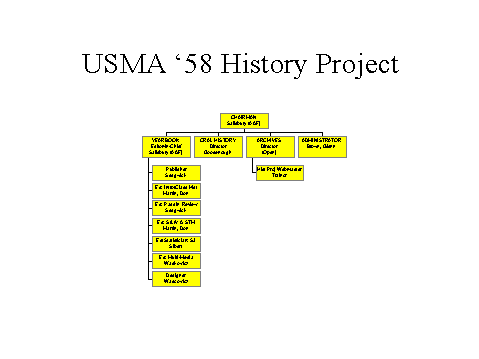
A brief description of the responsibilities of these positions follows:
Chairman: Responsible for the totality of the project, and to provide resources and assistance to each of the subprojects where requested.
Yearbook Editor-in-Chief: Responsible for the overall design and implementation of the 50th Reunion Yearbook in conjunction with the section editors. Enlist the support of volunteers as necessary. Develop a detailed schedule of milestones required to produce the final book in time for the 50th reunion.
Publisher: Solicit design proposals and bids from potential yearbook printers and multimedia disk providers. Prepare preliminary cost estimating parameters and provide guidance to the yearbook editors regarding design and layout and costing to help them refine the design and implementation of the book. Coordinate production and printing schedules, to determine required dates for submission of materials. Coordinate with editor-in-chief and chairman to make final selection of printer and multimedia provider. Oversee final distribution of final products.
Designer: Responsible for the overall design and layout of the 50th reunion yearbook; serves as art director and chief guru for all design and layout of the book.
Editor—Introduction & Class History: Responsible for collecting information and inputs and writing the “Brief History of the World and the Class of 1958” historical overview.
Editor-- Pass in Review: Responsible for the design and implementation of this section of the yearbook. Prepare questionnaires to solicit input for this section. Edit submitted materials and prepare supporting text in final form for submission to printer.
Editor—S/L/V & STM: Responsible for the design and implementation of these two sections (3 & 4) of the yearbook. Prepare questionnaires to solicit input for this section. Edit submitted materials and prepare supporting text in final form for submission to printer.
Editor/Statistician—S3: Responsible for the design and implementation of this section of the yearbook. Prepare questionnaires to solicit input for this section. Edit submitted materials and prepare supporting text in final form for submission to printer.
Editor – Multimedia: Responsible for the design and implementation of the multimedia inserts to the yearbook. Prepare questionnaires to solicit input for this section. Edit submitted materials and prepare supporting material in final form for submission to multimedia provider.
Director, Oral History: Responsible for the planning and implementation of the Oral (Audio/Video) History subproject. Enlist the support of volunteers as necessary. Develop a detailed schedule of milestones. Develop an Oral/Video History Guide document to be sent to each classmate along with the data collection solicitation.
Director, USMA ’58 Archives: Responsible for the planning and implementation of the class archives. Enlist the support of volunteers as necessary. Develop an appropriate cataloging scheme and a searchable database to catalog items in the archives. Arrange for the storage of the physical items, to include a suitable ultimate repository for the archives that will endure beyond the lifetime of the class.
History Project Webmaster: Develop and implement a class history website, linked to the existing class home page. (May be a direct extension of the existing home page, or separate site hot linked to the home page.) In coordination with the archives, provide access to digitized materials (photos, documents etc) on the site to the maximum extent possible. In coordination with the yearbook editors, create on-line capability for classmates to submit materials (as per questionnaires or freeform) for inclusion in the yearbook or archives.
Administrator: Integrates questionnaires from various editors into a single solicitation package with cover letter from the project chairman. Distributes (direct mailing or via AOG) solicitation package mailing(s) to classmates and logs responses as materials are received (including on-line submissions). Cajoles, jawbones and otherwise intimidates classmates into submitting requested materials. Distributes materials or copies to the various editors for editing and layout into yearbook or other products. Tracks progress of project tasks to keep activities on schedule.
The above brief statements of responsibility are a suggested starting point for each of the positions. It is expected that these will be refined and modified, as appropriate, to allow the incumbent volunteers freedom to put their own stamps on their projects.
VII:
LOGISTICS:
Communications: To facilitate communication between history project committee members, a two special e-mail address groups will be established. (These are 58HistoryTeam@west-point.org for the project team leaders listed on the org chart, and 58HistorySupport@west-point.org for other supporting members and assistants.) Most of the communication between committee members can be done via e-mail or using the web-site. The web-site will also include a roster of the committee members and their roles.
Expenses: It is anticipated that reasonable expenses for this project can be covered by available class funds. Committee members should consider what expenses they anticipate incurring, and submit them to the chairman to establish a budget. The chairman is prepared to solicit special donations to support this project if that becomes necessary.
NOTES RELATING TO CLASS OF ’58 HISTORY PROJECT
PLAN
1. It has been suggested that a goal of the “class history” (Section 1 of the reunion yearbook) should be to mention each classmate at least once.
2. Would be worthwhile to solicit classes ahead of us for lesson learned re their major reunion yearbooks.
3. Our data collection should ask classmates what unique memorabilia they may have that could be reproduced in the yearbook (and returned to them).
4. Consider establishing standards for the submission of materials, especially those that may be submitted digitally. Compression formats, dots per inch, and similar standards would make it significantly easier to use and/or distribute these materials.
5. Assuming we collect some great materials, we should consider working with the West Point Museum to have a Class of 58 exhibit during the time of our 50th reunion.
6. I am told that we still have (somewhere?) the original “Guiness Book of Records” of ’58 data that was collected for our 30th, and that Dave Turner did an alternative questionnaire and has data also. This could be useful in preparing Section 5 (S3) of the yearbook.
7. Also for Stars, Stripes and Stats (S3), it has been suggested that we “memorialize our class athletic feats.”
8. Glen Brown has suggested that we work with the Carlisle Barracks’ Military History Institute in collecting archive materials, and that they might like to be the ultimate repository for them. They would be an excellent source of advice on how to organize and catalog the materials. They have a web page at http://carlisle-www.army.mil/usamhi/