FIRST AUTHOR AND SECOND AUTHOR
Theodore Metzler and Rafael Ortiz
Advancia Corporation
211 SW A Ave.
Lawton, OK 73501-4051
metzlert@advancia.com , ortizr@advancia.com
ABSTRACT:
The U.S. Border Patrol (USBP) is authorized to increase its staffing substantially and needs to assign its new personnel to locations and tasks that will optimize their effectiveness. The computer-based simulation tool we developed to assist the Border Patrol with this planning task presents technically interesting design challenges, requiring modeling of interaction between USBP stations and localized populations adjacent to them across the border. Predicting behavior of these populations in response to USBP operations, and to other ambient conditions such as work opportunities and weather, involves simulation of systems that are neither time invariant nor linear. Moreover, distinct demographic groups in these populations, such as juveniles or adult males, respond differently to various incentives and USBP deterrents when deciding whether to cross illegally into the U.S. In fact, experienced USBP personnel can articulate heuristics describing these behavioral responses, and the rules they furnish typically display graded (vs "crisp") reasoning. These considerations, and user preference for a tool capable of explaining its predictions, led us to select fuzzy logic methods for modeling population behavior. Our resulting solution, with fuzzy logic-based "demographic agents" performing graded temporal and spatial reasoning, is described in this paper.
APPLICATION PROBLEM
Computer-based simulation of USBP operations can determine staffing required for meeting effectiveness objectives only by including illegal behaviors of alien populations the Border Patrol Agents (BPAs) typically engage. Although numbers of BPAs needed for prescribed levels of border control can be estimated through stochastic simulation of the tasks involved, quantitative workload of alien intrusions driving those tasks must first be projected. Workload, in turn, is a function of at least some of the USBP operations. Modeling this interaction between alien behavior and USBP staff operations constitutes an interestingly difficult application problem.
One might initially assume, for example, that the level of illegal border crossings in a given area should be inversely related to prior local success by BPAs in apprehending illegal crossers. Somewhat surprisingly, research on this relation (Espenshade, 1994; GAO, 1993) has failed to support the expectation. In fact, rates of USBP apprehensions appear not to be a sound basis for projecting levels of undocumented migration (Passel, 1990), since aliens do not generally respond to apprehension as an effective deterrent (Espenshade, 1993).
On the other hand, persistent stationing of visible BPAs and their vehicles along the border near El Paso, Texas, has produced clear evidence of a deterrent effect (GAO, 1994; Martin, 1995). Knowledge acquisition interviews we have conducted with experienced USBP personnel in El Paso also indicate similar effects follow deployment of Border Patrol resources such as nighttime lighting and fencing. Understandably, the deterrent impact of these measures is further conditioned by alien demographic features such as gender and age. Describing interactions of this kind is most naturally conducted in "graded" terms such as "high" visibility or "moderate" reductions of illegal crossing.
Despite prevention initiatives by USBP, there are also opposing factors that regularly continue to generate a traffic of illegal border crossings. Amplitude of this flow varies in part as a sum of temporal components. It typically increases around February, reflecting seasonal levels of job opportunity, and decreases in November and December as migrants return home for the holidays (Espenshade, 1994). Demographic factors also appear to modulate the flow. For example, the phenomenon of pregnant women illegally crossing the border to give birth in the United States has shown evidence of a consistent annual pattern (Bean, 1994).
Although illegal crossings are motivated and deterred by numerous factors, our prototype Staffing Model cannot incorporate all of them. We have identified a basic set of about seventy variables (such as apprehensions and BPA staffing levels) that allows testable modeling of important interactions between USBP stations in the El Paso Sector and the alien populations they normally encounter.
TECHNICAL APPROACH
In addition to inherent features of the application problem, our technical approach has been constrained by specific Border Patrol requirements for a flexible and understandable planning tool. Although computational models have previously been developed to predict flows of migration (Massey, 1993), their equations typically fail to capture the types of local reasoning by prospective illegal border crossers that create shifting staff requirements among USBP "line stations." When a particular USBP station, for example, increases the number and visibility of its BPAs along the segment of border it manages, members of the alien population who would normally attempt illegal crossing at that point are likely to be deterred by the "high" visibility and begin showing a graded preference for crossing instead near less forbidding adjacent stations to the east or west. Dynamic workload shifts of this kind are exactly what USBP planners require their computer simulation tools to represent as they prepare recommendations for new staffing. Moreover, the planners need tools capable of giving reasons for the recommendations produced; e.g., "Increased BPA visibility has reduced illegal crossing at Station Z."
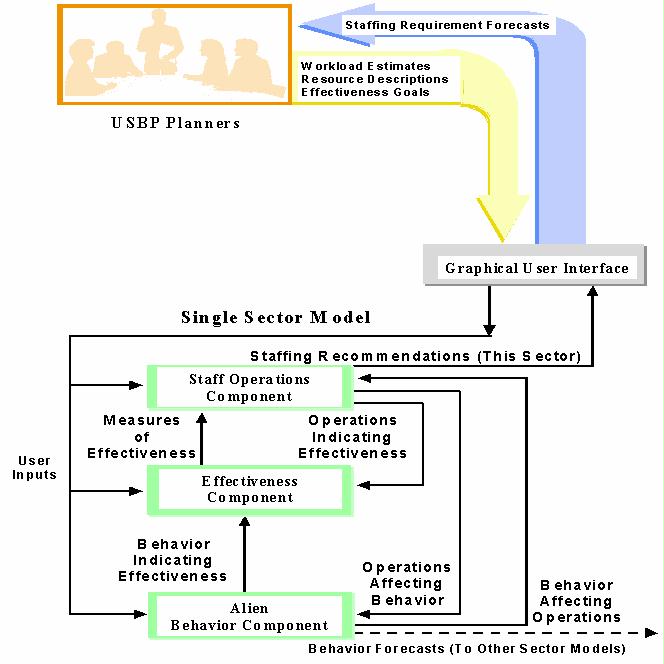
Diversion scenarios of the sort just described can be simulated with linked modeling components. The Alien Behavior component shown in Figure 1 initiates each processing cycle of such simulations by projecting levels of illegal alien activity for the next twenty-four hours of simulation time at each station in the El Paso USBP Sector. Models of these stations within the Staff Operations component respond by simulating a day of USBP operations aimed at coping with the illegal activity. The Effectiveness component then compares projected illegal activities with apprehensions and other factors to compute measures of border control and effectiveness for each USBP station. In one of the operational modes that the Border Patrol planner can select, daily outputs of the Effectiveness component help the Staff Operations component identify required staffing changes as the simulation progresses.
In the "real world," diversions of attempted illegal crossings among USBP stations are performed by intelligent agents who experience the Border Patrol primarily as an obstacle. They must balance their graded motivations against deterrents and use both spatial and temporal reasoning to evade apprehension by USBP officers. Moreover, they are readily capable of explaining their strategies. They are, in sum, exactly the kinds of intelligent agents who can be appropriately modeled with fuzzy logic, the mathematical background of which has now matured over several decades (Zadeh, 1965).
We used FuzzyCLIPS to implement specialized fuzzy inference systems in the Alien Behavior component shown in Figure 1, modeling behavior of three demographic groups (adult males, adult females and juveniles). In addition, we conducted statistical test data analysis and rapid fuzzy logic prototyping with corresponding MATLAB toolboxes; some results of these efforts are described in the following.
RESULTS
We collected test data for a representative two month period from the El Paso USBP Sector. The data recorded day-to-day fluctuations in USBP operations, such as staffing levels, task assignments and alien apprehensions.
First objectives of the analysis were to identify significant variations of the test data, and to search for significant relationships between data elements. We used Analysis of Variance (ANOVA) to identify data elements showing a significant variance. Data elements not showing a significant change should have a minimal impact on the results of the simulation, recommending their elimination from the model.
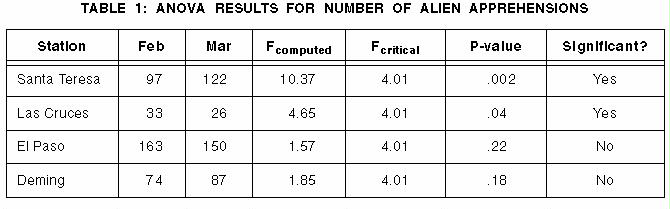
In our initial analysis of test data, we examined the data element corresponding to the number of apprehensions of illegal aliens. We found significant variation in the number of aliens apprehended at two of the four USBP stations studied (Santa Teresa and Las Cruces). Table 1 summarizes the results of this analysis. The table shows the number of alien apprehensions by month, and the appropriate ANOVA statistics by which we determined the significance of the variation in this data element.
We also used regression analysis to begin exploring whether there might be significant correlations among data elements. Testing whether the data we obtained showed a significant relationship between assignment of USBP agents and the number of aliens they apprehended, we found no significant relation. Table 2 shows the summary of our findings, including the R2 values we computed.
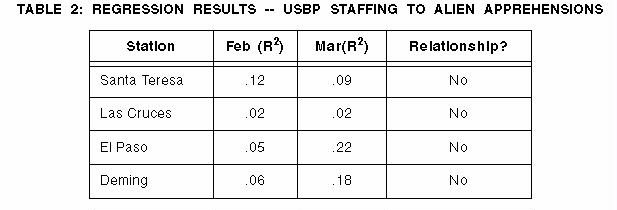
In view of these results, we retained both data elements in the Staffing Model and continued analyzing others for significant variations, for we had determined the data element pertaining to staffing levels does not, by itself, have a direct relationship with the number of alien apprehensions in our sample of data.
In each processing cycle of a simulation, the Alien Behavior component of the Staffing Model must predict seven kinds of alien activity, such as illegal border crossing and illegal movement within the United States by public transportation. It projects levels of these behaviors for three demographic subgroups from each user-specified population center and for each station area in the El Paso USBP Sector. The projections are accomplished by sets of fuzzy inference systems (FISs) that generally use specialized rules and membership functions for each demographic subgroup. For example, an FIS responsible for evaluating each USBP station's current deterrent impact on illegal crossings by adult males may apply its rules to values of input data elements representing BPA visibility and artificial physical barriers.
Other input data elements of this kind include current alien smuggling prices, fluctuating Dollar/Peso exchange ratios and motivations for migration presented by foreign unemployment problems; altogether, the Alien Behavior component employs about sixteen such input data elements. We generally use three membership functions to specify values of these data elements in the fuzzy logic rules of our Staffing Model. Accordingly, "If BPA Visibility is HIGH and Artificial Physical Barriers are MEDIUM, then Station Physical Deterrent is HIGH" represents a typical rule in our system. Because this simple illustration involves a conjunction of two data elements in the antecedent--each specified by any of three membership functions--a total of nine distinct rules could reasonably be composed from combinations of its elements. In the general case, an FIS with n input data elements (using three membership functions each) can contain as many as 3n rules.
Because the Alien Behavior component of our Staffing Model must accept sixteen input data elements to perform its reasoning concerning alien motivations, the formula just mentioned suggests a "worst case" possibility of 316 rules for each of three demographic subgroups. Clearly, a combinatorial explosion producing in the order of 130 million rules represents a practical design problem. Our solution was to decompose the input and build modular networks of smaller FISs. The rule reduction gained by this simple strategy was remarkable, allowing the motivational reasoning to be accomplished with less than one thousand rules.
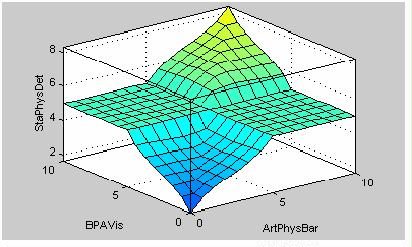
Figure 2 displays the graded output surface for an illustration of the kinds of modular FISs we used. Generated with graphical resources of the MATLAB Fuzzy Logic Toolbox, it shows how graded input values for BPA Visibility ("BPAVis") and Artificial Physical Barriers ("ArtPhysBar") result in graded values of Station Physical Deterrent ("StaPhysDet"). For example, if the inputs (shown on the x and y axes of Figure 2) have a value of zero, the graded value for the output (shown on the z axis) is zero. With increasing input values, the deterrent grows as depicted.
In addition to modeling the deterrents and motivations that result in net levels of illegal alien activities, our Alien Behavior component is required to express those activities in terms reflecting spatial and temporal conditions of the El Paso USBP Sector. For example, diversions of illegal crossings toward USBP stations west of El Paso can involve temporal delays caused by difficult transportation conditions.
ACKNOWLEDGEMENTS
Special thanks are due Karen Hess, USBP Senior Program Analyst, and Steve Niblet, USBP Assistant Chief Patrol Agent, for their valuable assistance and support.
REFERENCES
Bean, Frank D.; Chanove, Roland; Cushing, Robert G.; de la Garza, Rodolfo; Freeman, Gary; Haynes, Charles W.; and Spener, David. Illegal Mexican Migration and the United States/Mexico Border: The Effects of Operation Hold-the-Line on El Paso/Juarez. Austin, Texas: Population Research Center, The University of Texas at Austin, 1994.
Border Control: Revised Strategy is Showing Some Positive Results. Report GAO/GGD-95-30. Washington, D.C.: United States General Accounting Office, December, 1994.
Espenshade, Thomas J. "Does the Threat of Border Apprehension Deter Undocumented US Immigration?" Population and Development Review (20:4), pp. 871-892, December, 1994.
Espenshade, Thomas J., and Acevedo, Dolores. "Migrant Cohort Size, Enforcement Effort, and the Apprehension of Undocumented Aliens." Princeton, New Jersey: Office of Population Research, Princeton University, September,1993.
Illegal Aliens: Despite Data Limitations, Current Methods Provide Better Population Estimates. Report GAO/PEMD-93-25. Washington, D.C.: United States General Accounting Office, August, 1993.
Martin, John L. "Can We Control the Border? A Look at Recent Efforts in San Diego, El Paso and Nogales." Center Paper 8. Washington, D.C.: Center for Immigration Studies, May, 1995.
Massey, Douglas S.; Arango, Joaquin; Hugo, Graeme; Kauaouci, Ali; Pellegrino, Adela; and Taylor, J. Edward. "Theories of International Migration: A Review and Appraisal." Population and Development Review (19:3), pp. 431-466, September, 1993.
Passel, Jeffrey S.; Bean, Frank D; and Edmonston, Barry. "Undocumented migration since IRCA: An overall assessment." In Frank D. Bean, Barry Edmonston, and Jeffrey S. Passel (eds.), Undocumented Migration to the United States: IRCA and the Experience of the 1980s, pp. 251-265. Washington, D.C.: The Urban Institute Press, 1990.
Zadeh, L. A. "Fuzzy Sets." Information and Control (8), pp. 338-353, 1965.
Note: This paper was accepted for and presented at the "Artificial Neural Networks In Engineering" conference held in St. Louis, Missouri in November 1997 (ANNIE '97). It was also published in the ANNIE '97 conference proceedings by the American Society of Mechanical Engineers (ASME Press) as a hardbound book titled Smart Engineering Systems: Neural Networks, Fuzzy Logic, Data Mining and Evolutionary Programming.