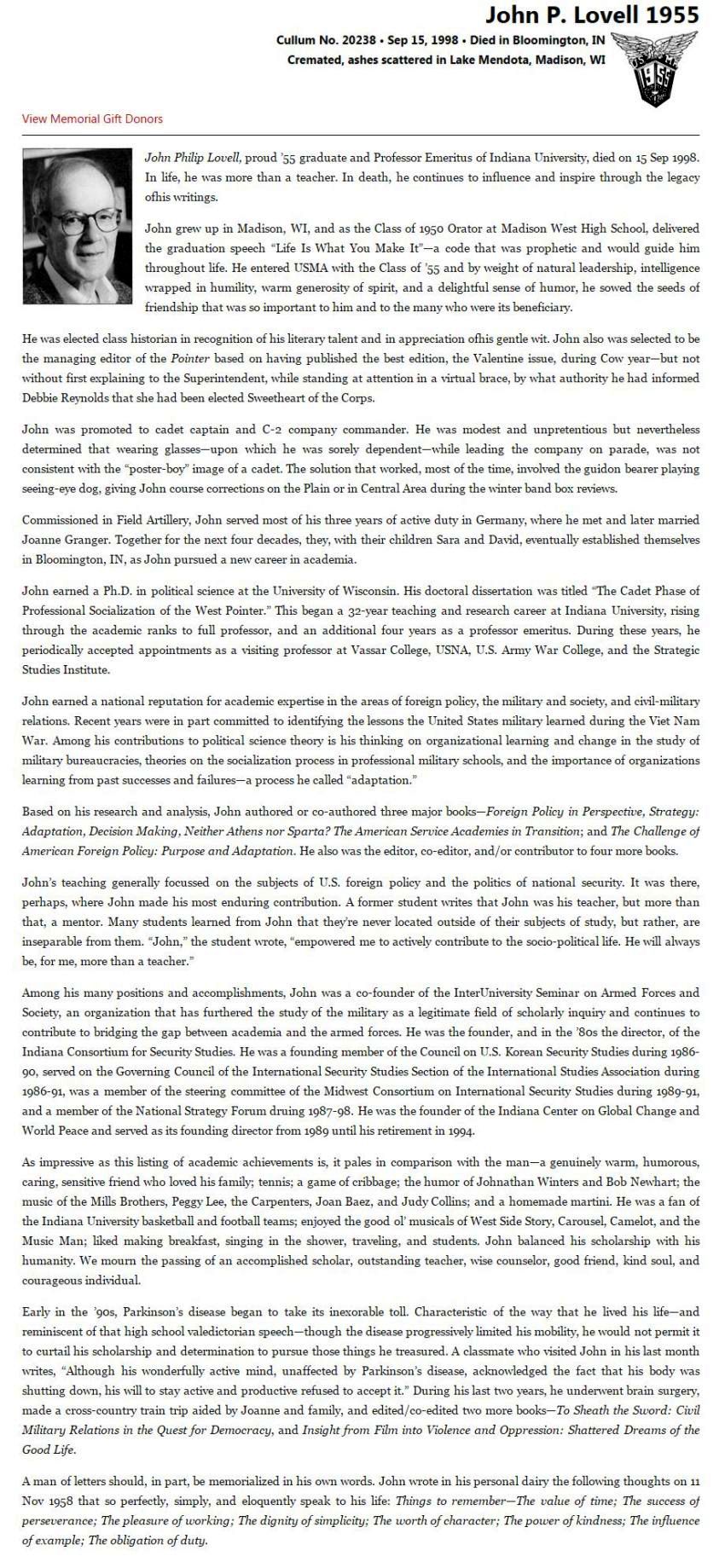
John P. Lovell
Political Scientist
John P. Lovell, professor emeritus of political science at Indiana University and founding director of the Indiana Center on Global Change and World Peace, died on September 15, 1998, at his Bloomington residence, of Parkinson's disease. He was 66 years old.
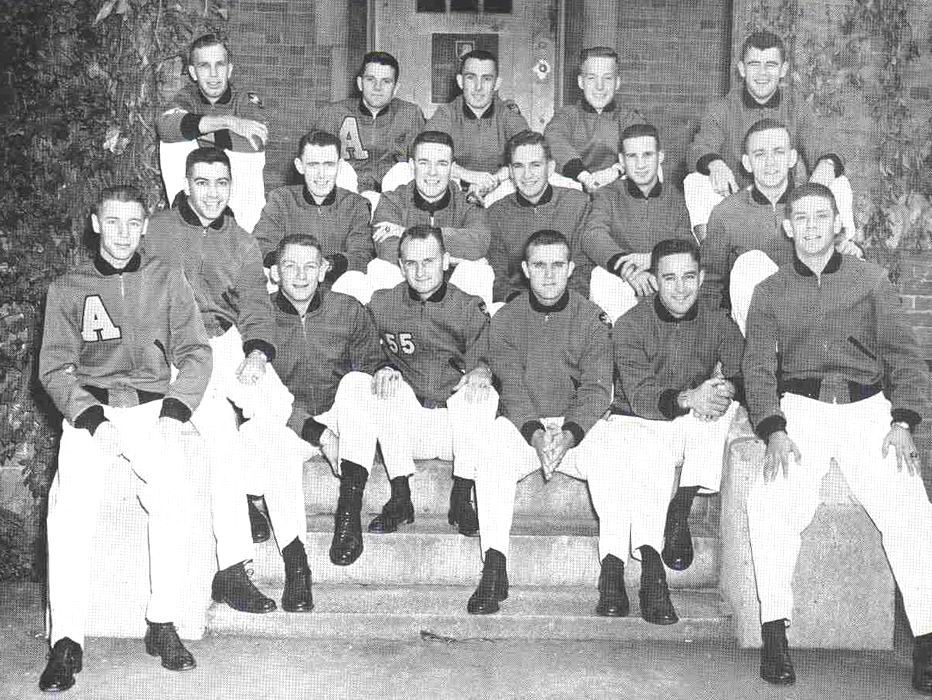
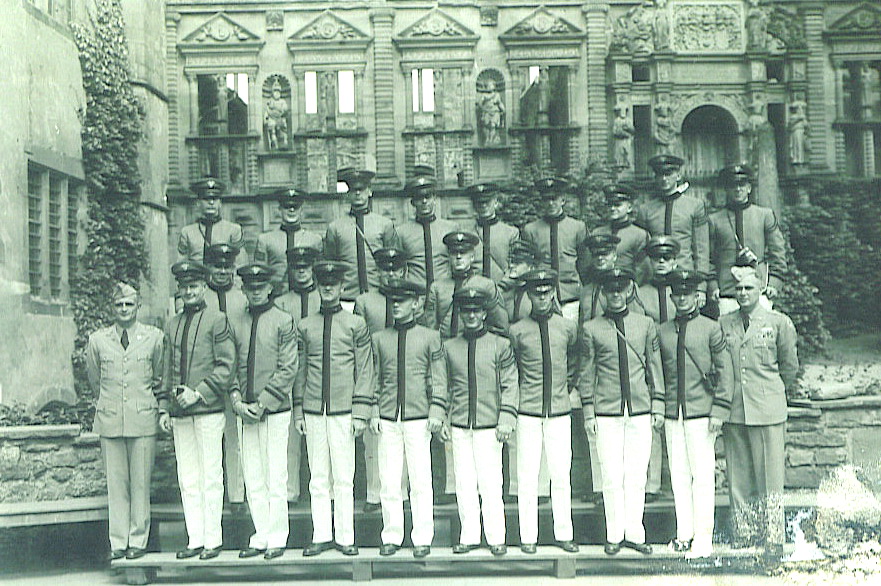
John was born in Racine, Wisconsin, in 1932, the youngest son of Frank and Nyla Metcalf Lovell. He grew up in Madison. He was a 1955 graduate of the U.S. Military Academy and served as class historian. Commissioned in Field Artillery, John served most of his three years of active duty in Germany, where he met and later married Joanne Granger. Together for the next four decades, they, with their children Sara and David, eventually established themselves in Bloomington, IN, as John pursued a new career in academia.
In 1958, he pursued graduate studies in political science at the University of Wisconsin, Madison. His graduate school honors included a Knapp Fellowship and a University of Wisconsin Fellowship. He received his Ph.D. in 1962. His doctoral dissertation was titled 'The Cadet Phase of Professional Socialization of the West Pointer.
John Philip Lovell was professor of political science and founding director of the Indiana Center on Global Change and World Peace (now the Center for the Study of Global Change) and the Indiana Consortium for Security Studies at Indiana University Bloomington almost continuously from 1962 until his death on September 15, 1998.
Lovell was born in Racine Wisconsin on August 12, 1932. After graduating from the U.S. Military Academy at West Point in 1955, he earned M.A. and Ph.D. degrees from the University of Wisconsin Madison in 1959 and 1962, respectively.
Lovell began his teaching career at IUB in 1962, specializing in the relationships between society and the military, U.S. foreign policy, national security policy, international politics, and peace studies. During the span of his 32-year career, Lovell held visiting professorships at the U. S. Naval Academy, the U.S. Army War College, the Strategic Studies Institute in London, the University of Wisconsin Milwaukee, and Vassar College; authored or co-authored numerous books, journal articles, chapters in edited volumes, and book reviews; delivered invited, public lectures; and appeared before the media. He retired in 1994 and subsequently was named professor emeritus.
* * * * * * * * * * * * * * * * * * * * * *
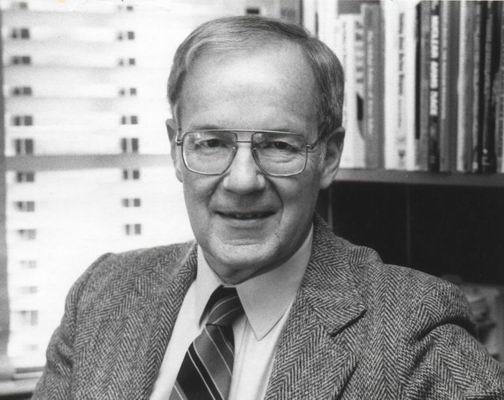
Memorial Resolution
JOHN P. LOVELL
(1932 - 1998)
John P. Lovell, Professor Emeritus of Political Science at Indiana University Bloomington and founding director of the Indiana Center of Global Change and World Peace, died at his Bloomington residence on September 15, 1998. He was sixty-six years old.
John was born in Racine, Wisconsin. After undergraduate training at the U.S. Military Academy, he completed his military service and entered graduate study in political science at the University of Wisconsin at Madison, where he earned his Ph.D. in 1962. In that same year he began his teaching career at IUB, getting promoted through the ranks to full professor by 1971. During his thirty-two years of teaching, he held visiting professorships at the U.S. Naval Academy (1971-72), the U.S. Army War College (1978-79), and the Army War College in Carlisle, Pennsylvania (1984-85). He retired from IUB in 1994.
John Lovell's research dealt primarily with civil-military relations, and particularly the complex relationships between the armed forces and society. He spent the latter portion of his career pursuing the questions of what lessons the military had learned from its experiences in the war in Vietnam.
He was also very interested in questions related to U.S. participation in the Korean War, and he visited South Korea on a number of occasions. His theoretical contributions included the application and testing of models of cognition and organizational learning and change in the study of military bureaucracies and the application of theories of socialization to professional military schools. His books on foreign policy stressed the importance of learning from past successes and failures, which he called 'adaptation."
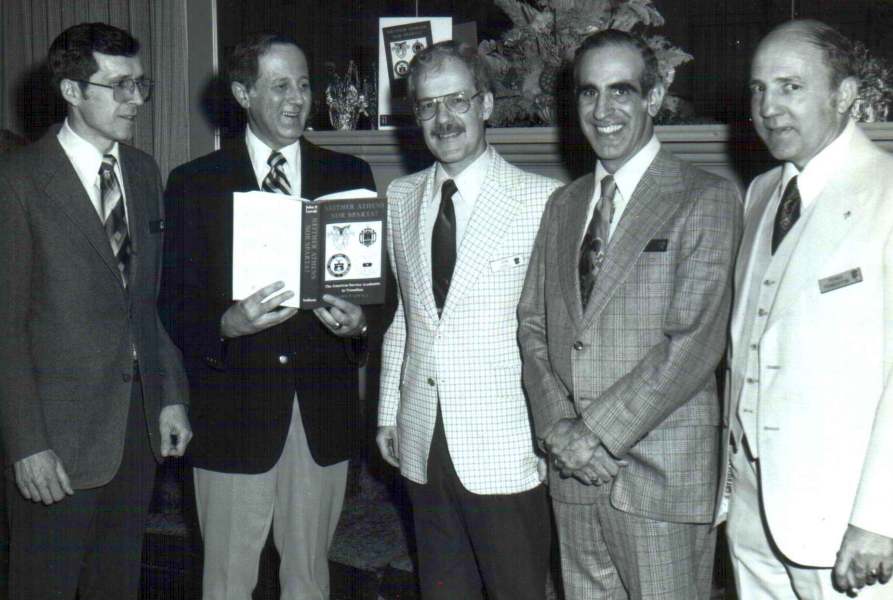
John Lovell authored or co-authored three major books: Foreign Policy in Perspective: Strategy, Adaptation, Decision Making (1970); Neither Athens nor Sparta? The American Service Academies in Transition (1979); and The Challenge of American Foreign Policy: Purpose and Adaptation (1985). In addition, he was editor or co-editor of four volumes, two of which were completed within the past two years: To Sheathe the Sword: Civil-Military Relations in the Quest for Democracy (1997); and Insight from Film into Violence and Oppression: Shattered Dreams of the Good Life (1998). He published numerous journal articles and chapters in edited volumes, and his book review appeared in a wide range of journals.
The courses that Professor Lovell taught were mainly on U.S. foreign policy and the politics of rational security, as well as courses on international politics and on war and peace. In teaching about international affairs, he was an early pioneer in the use of feature-length films. Throughout his career, he gave numerous public lectures and appeared on radio and television programs.
In 1989, John Lovell became the founding director of the Indiana Center on Global Change and World Peace (now the Center for the Study of Global Change), with major initial funding from the MacArthur Foundation, and he remained its director until his retirement in 1994.
The obituary published in the Wisconsin State Journal (Madison) accurately sums up the emotion of many who heard of his passing: 'Throughout his life and academic career, generations have found in John a good friend, a wise counselor, and a kind soul.' A scholarship fund has been established in John Lovell's name, and contributions may be made through the Indiana University Foundation.
His colleagues request that this memorial resolution be presented to the Bloomington Faculty Council and be made part of its minutes, and that copies be sent to the President of the University, the University Archives, and to the family members and friends named on the appended page.
Jeffrey Hart
|