Appendix C
West Point Cemetery
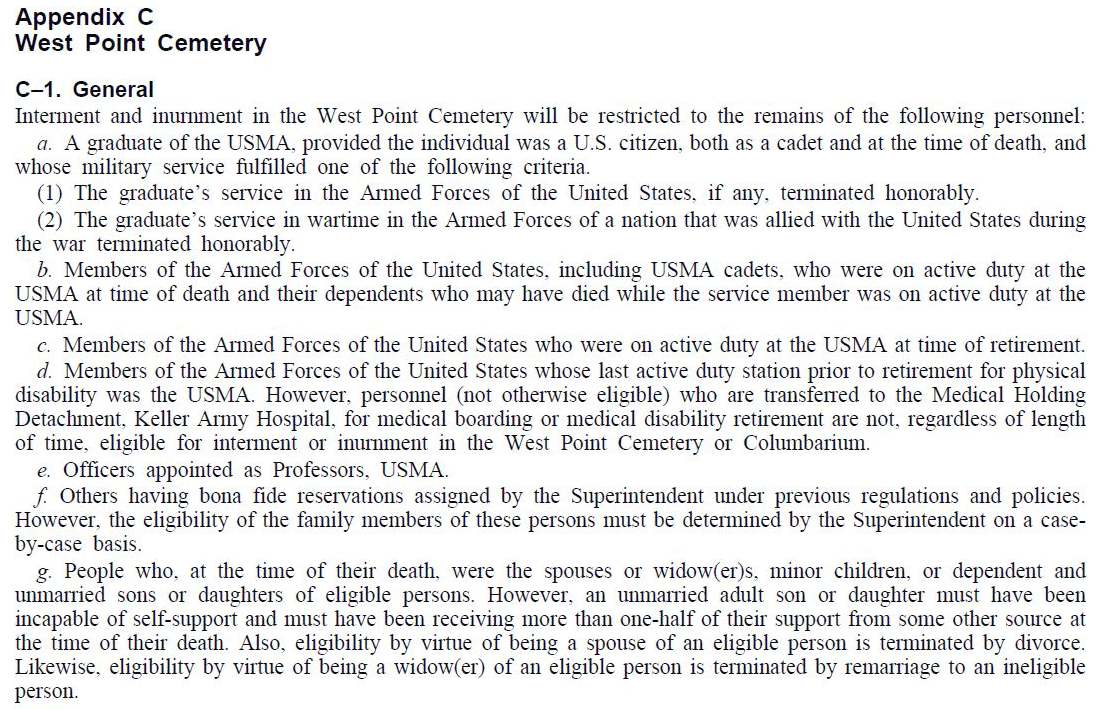
C–1. General
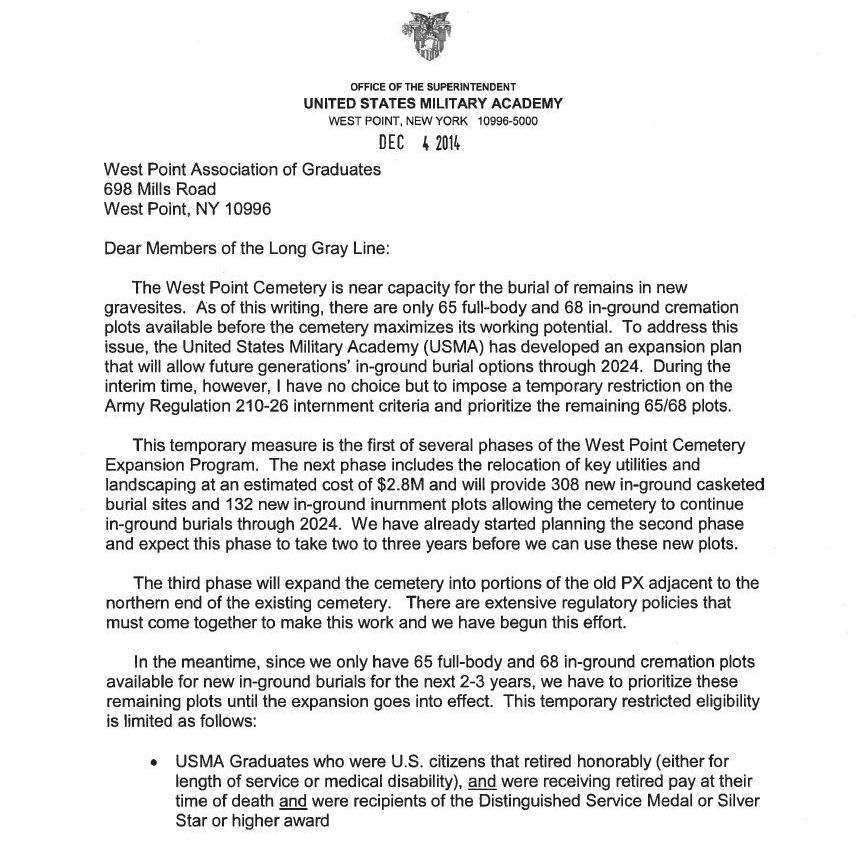
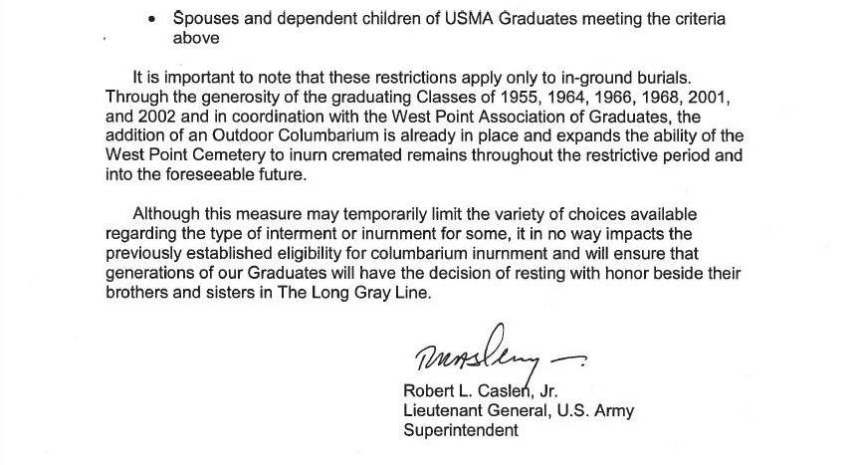
Interment and inurnment in the West Point Cemetery will be restricted to the remains of the following personnel:
a. A graduate of the USMA, provided the individual was a U.S. citizen, both as a cadet and at the time of death, and whose military service fulfilled one of the following criteria.
(1) The graduate's service in the Armed Forces of the United States, if any, terminated honorably.
(2) The graduate's service in wartime in the Armed Forces of a nation that was allied with the United States during the war terminated honorably.
b. Members of the Armed Forces of the United States, including USMA cadets, who were on active duty at the USMA at time of death and their dependents who may have died while the service member was on active duty at the USMA.
c. Members of the Armed Forces of the United States who were on active duty at the USMA at time of retirement.
d. Members of the Armed Forces of the United States whose last active duty station prior to retirement for physical disability was the USMA. However, personnel (not otherwise eligible) who are transferred to the Medical Holding Detachment, Keller Army Hospital, for medical boarding or medical disability retirement are not, regardless of length of time, eligible for interment or inurnment in the West Point Cemetery or Columbarium.
e. Officers appointed as Professors, USMA.
f. Others having bona fide reservations assigned by the Superintendent under previous regulations and policies. However, the eligibility of the family members of these persons must be determined by the Superintendent on a caseby- case basis.
g. People who, at the time of their death, were the spouses or widow(er)s, minor children, or dependent and unmarried sons or daughters of eligible persons. However, an unmarried adult son or daughter must have been incapable of self-support and must have been receiving more than one-half of their support from some other source at the time of their death. Also, eligibility by virtue of being a spouse of an eligible person is terminated by divorce. Likewise, eligibility by virtue of being a widow(er) of an eligible person is terminated by remarriage to an ineligible person.
C–2. Conviction of capital crime
Any individual mentioned in (a) through (g) convicted or found to have committed a capital crime, as referred to in 38 USC 2411 (b), is prohibited from interment and inurnment in the West Point Cemetery. This prohibition shall only apply if the Superintendent, the United States Military Academy, receives written notification of the conviction or finding from the Attorney General, in the case of a Federal capital crime, or by an appropriate State official, in the case of a State capital crime. For this paragraph to apply, the Superintendent must receive the written notification of the conviction or finding prior to approval of the application/request for interment and inurnment.
|