Sweden has only been Sweden for a few hundred years, but there have been people living on that land for thousands, perhaps tens of thousands of years. Most of that time was similar. Life was basic. The land was rocky and forested making agriculture difficult. The growing season was short and most of the year was cold and dark. Life was hard. People knew little about sanitation or nutrition and life expectancies were short. After the introduction of Christianity, the people developed deep religious convictions and practices. They coped with illness, hardship and early death by relying on a merciful God Who ordered all things and Who, alone, understood their purpose.
In the 1800s knowledge of sanitation and medicine increased dramatically, greatly reducing infant mortality and lengthening people’s productive lives. While that may sound like a wonderful thing, and it was, it had unexpected consequences which greatly upset the status quo in Sweden. The population, which had been held relatively stable for centuries, exploded. Families were accustomed to having ten or more babies, of which one or two might reach adulthood. Suddenly, families found themselves trying to support a lot of children, who eventually became adults with too little land to support them. Clearing new land was nearly impossible because of the heavy forestation and the rocks. It is difficult to appreciate how rocky Sweden is until you see it. Huge rocks are everywhere, even in cleared farmland. Rocks work their way to the surface, rerocking cleared land. With just their own strength and a horse or two, the Swedes could not clear land as fast as the population was growing.
There was considerable suffering in Sweden for many years as a result of that population explosion. People from the rural areas crowded into the cities only to find no work there and no place to stay. The hardship in Sweden created a national urge to leave that miserable environment.
At the same time, the new world, the United States, was beginning to capture the imagination of most of the world. People in distress all over Europe were finding their way to the United States and many did well there. Stories of former neighbors becoming rich in the new land were plentiful.
Then another technological development occurred that opened the flood gates in Sweden. Steamship travel made mass migration possible and affordable, and railroads were built into the Swedish interior making it possible to reach the ports. In fact, the railroad era had much more to do with the emigration than that. American railroads were being built across the continent.
Not only were Swedes the preferred laborers for railroad construction, but the railroad companies were anxious to populate the prairie to produce goods and demand for rail service. The American railroads offered incentives such as free transportation to the Midwest for Swedes in particular. The railroads sent hucksters to Sweden to convince people to move to the Midwestern US.
The Midwest must have seemed like paradise to the beleaguered Swedes. The prairie did require some initial hard work to bust the sod, but the rich soil, totally devoid of rocks and tree roots, was primed and ready to burst forth with crops. The land was free for homesteaders, and the railroads would often take you there for little or for free.
Out of a population of about 2
million, one million Swedes emigrated to the United States and Canada in
the latter half of the 19th century.
THE THORSONS
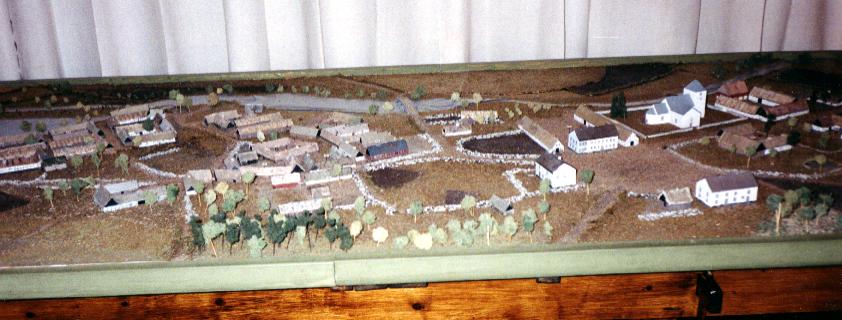
In the village of Hörby the family of Thore Jonsson included five sons and a daughter. The family had a small farm in the town. With six boys in the family surviving to adulthood, a crisis was about to occur. Swen, the eldest, was to inherit the farm. No matter how much he might have wanted to share with his brothers, there was no way that the small farm could support five farmers and their future families. In Horby we found a terrain table showing the Jonsson Farm. Above the cluster of trees is our ancestral Swedish farm. The gamla torg (main market/square) and church are to the right and higher.
The railroad came right through Hörby. The station is still there, directly across the street from the old courthouse and less than an American mile from Thore’s farm. Railroad hucksters probably visited the town often, using it as an entry point to the surrounding countryside. No doubt the four sons of Thore (the Thoressons) who faced an uncertain and unpromising future in Sweden, were easy sells on the prospect of moving to the Midwest and homesteading farms there.
I believe that this move was not nearly as frightening as it might seem now. These young men knew farming and they would be among their former countrymen. The Midwest was populated with many Swedes who clumped together in communities so that they would have each other to rely on while they learned American customs and to speak English. It was just the youngest two who initially came to America, apparently as a scouting party.
It is interesting to speculate about the views of the parents on this event. Having most of the offspring move to a foreign country, probably never to be seen again, must have been a terrible prospect. But, the Thore Jonssons must have been frightened about what awaited these young men in Hörby with no farm or other means of livelihood.
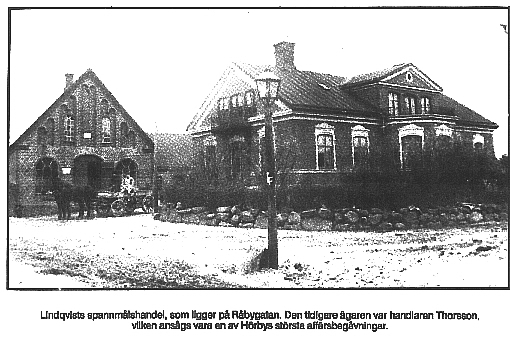
A picture, taken from a 1990 calendar
and showing scenes from old Hörby, tells us that this is Thorrson’s
warehouse and that Thorrson is one of Hörby’s leading businessmen,
a grain dealer. What fate actually would have befallen the departing Thorssons
had they remained will never be known, of course, but it seems that they
might have done rather well, as did Swen. Little did they or anyone else
realize that the same mechanization which made transatlantic and transcontinental
travel possible, was about to make land clearing feasible, as well. Soon
heavy tractors became available to dig out the huge rocks, fell the trees,
and remove the roots. The Swedes who stayed found that they soon were able
to clear enough land to support the reduced population and they found a
market for their wood products that made Sweden a prosperous country. I
find it interesting that little of that country is cleared for agriculture
today. Even with mechanization, it must be more profitable to let the trees
grow and sell wood than to raise crops.