Early explorers who crossed the plains, for example the famous Zebulon Pike, called the Plains a wilderness incapable of cultivation. On early maps the Midwest was called "the Great American Desert." For years pioneers crossed the plains on their way west without thought of stopping, except in the cities that grew up at river crossings, such as at Omaha.
Then came the transcontinental railroad. The railroad needed workers who would both endure the hardships of laying a line across this desert and would work hard enough to ensure the road a handsome profit. The worker of choice was a Swede. Jay Gould reportedly said, "Give me enough whiskey and snuff and I will build a railroad to hell." The reference was to Swedes.
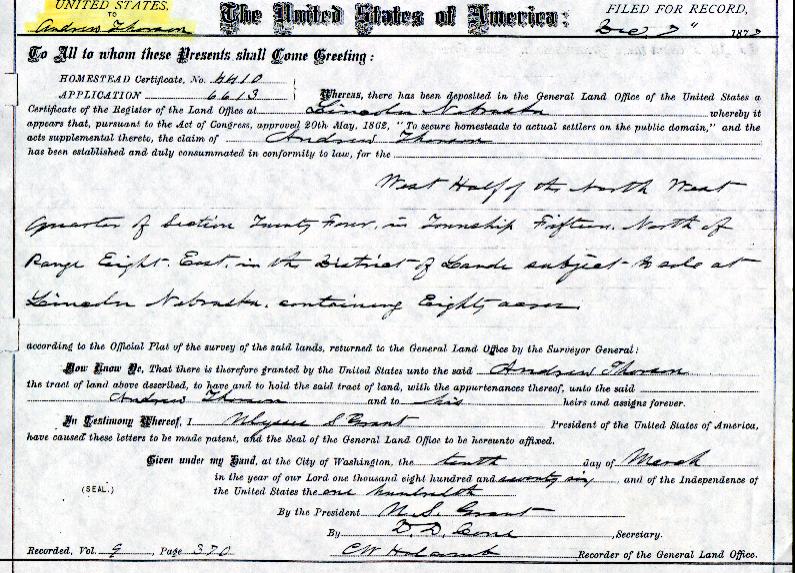
The Kansas-Nebraska Act created two new territories from land previously reserved for Indians. Then the Homestead Act of 1862 offered 160 acres to any settler who built a house and lived on the land for five years. With that, migration to the plains began in earnest, spurred on by the railroads. At the same time, political forces attempting to ensure either a pro- or antislavery population were subsidizing families moving to the new territories.
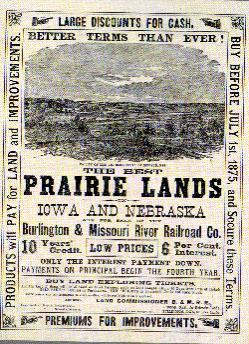
Following the end of the Civil War, both railroad companies and the territories themselves advertised for settlers promising land in a near paradise. People responded in great numbers. In 1872 a Nebraska settler wrote, "One year ago this was a vast houseless, uninhabited prairie, with no trace of approaching civilization to frighten the timid antelope, or turn the buffalo from his course. Today I can see more than thirty dwellings from my door yard."
Those of us, who have grown up on that land or at least visited there, know that it is far from paradise. I love it, myself, as it is the homeland of my ancestors as well as my birthplace, but objectively it isn't pretty, is often ugly in fact, and is a harsh environment. The one constant on the plains is the wind. It blows all the time and must have made early homebuilding a challenge. When the settlers arrived there weren't even any trees. It is no accident that Arbor Day is a Nebraska invention. Man planted all the trees in that part of the world.
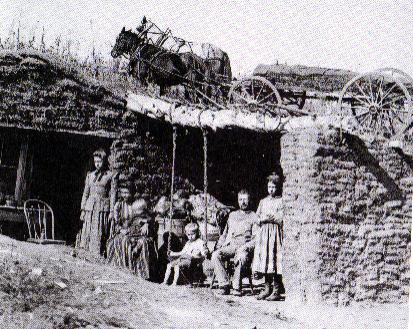
The settlers' first homes were usually dugouts. These could be made with just basic farming tools and the ubiquitous sod. Later an above ground sod house could be built, although keeping the weather and wildlife out of these houses was still difficult. Fairly warm in the winter and cool in the summer, soddies leaked in hard rains and admitted insects and snakes.
The first task for the new farmer was to break sod. This required a special plow and a lot of pulling power, normally several yoke of oxen. The only evidence we have of the Thorson brothers' beasts of burden is mention of one horse. They may have rented, borrowed, or bought the oxen to break that sod. Four related farmers working together would certainly have been advantageous in this process.
First crops were usually corn and the settlers' diets comprised corn, things made from corn flower, and whatever wildlife they could shoot. As noted above, at first there were antelope and buffalo in abundance, which, along with game birds, could have provided plenty of meat for their diets. Soon the farmers raised domestic animals, primarily chickens I would guess, as the wild animal population declined or moved away. In my youth, every farm had a chicken yard with something like 50 chickens running around in it.
Every morning the farmer's wife or daughter, usually, gathered all the eggs for eating and selling. Farm wives made a huge contribution by preparing meals, making and maintaining clothing, helping with planting, and selling excess butter and eggs.
Weather is both the blessing and the curse of the prairie. Warm moist air from the Gulf of Mexico collides all spring and summer with cold air masses from Canada. This produces abundant rainfall most of the time for water-hungry crops, such as corn. It also causes severe weather, producing violent thunderstorms and tornadoes.
Swarms of grasshoppers ravaged crops from 1874 to 1877, still discussed when I was a child sixty years later. Indians still lived on the plains and were increasingly frustrated and angered by the encroaching foreigners. It was a tough place to live. Disease, injuries and the privations of prairie life exacted a high toll on the pioneers, especially the young.
When I was little, my mother talked often of the pioneers whom she held in great reverence. I fear that we have forgotten their bravery and fortitude. Although the statistics are unavailable, it is known that many, perhaps most, of those who attempted to settle the Midwest gave up. They either went back to where they had come from or went on the California. Those who stayed and toughed it out were special indeed.
I am indebted to a number of sources for much of this information. Principally to Settling the West, a Time-Life Book, from which I took the pictures and some of the text. Centennial by James Michner and a book about Kansas by Jane Smiley provided additional insights.