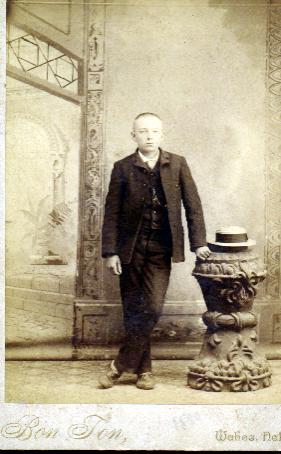
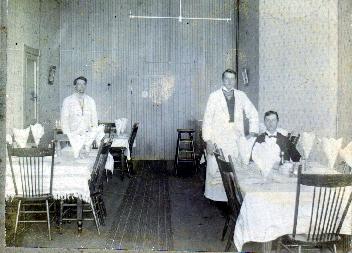
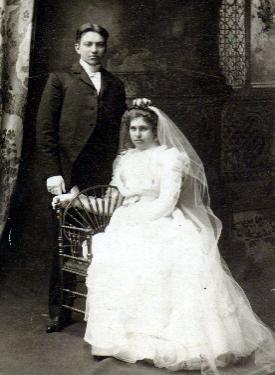
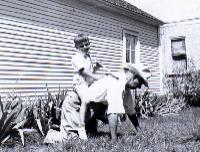
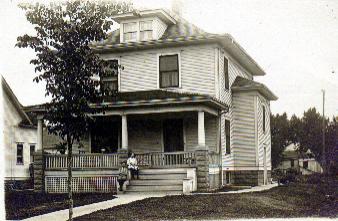
We will have to guess a lot about Charley Thorson’s youth since the family folk lore doesn’t include it, more’s the pity. He would have spent most of it in on the farm or in Mead and, without a doubt, worked for his parents in the beanery. Before the family moved to town he attended a country school which is still standing near the farms. At some point he moved to Lincoln, probably upon finishing school. Dorothy believes that he worked as a waiter in the Cornhusker Hotel. By the time Dorothy was aware of what he did he owned and ran his own beanery. I have yet to find the beanery, but Hal says it was originally west of Lincoln near the roundhouse, both of which are now long gone. After that it was at the SE corner of 7th and L, across from the Beatrice Creamery. The building is no longer there and the raggety building that is there is, in Hal’s estimation, a step up from the Beanery. Better information on Charley's beaneries.
Grandpere was his official name for his grand kids. Apparently I was the only one who changed that to Grampy or Gramp. He was 61 years older than I so my earliest memories of him are of a senior citizen. He was just about the perfect grandfather -- patient and caring, helpful but unintrusive. My experience with him includes living in his house, his living in our house, and seeing him when he lived with his other children.
Until I was about six, he lived at 1321 Garfield Street. We lived with him and Grandmere until I was three, when we moved to our own house at 3760 Garfield. I have only one or two memories of living in their house and a few of visiting there after we moved.
When we visited 1321 I would often receive a cigar box as a gift. I’ve never smoked and am almost always annoyed by cigar smoke, but in those days one of the sweetest smells in the world was the cigar box. His doctor made him quit smoking cigars at some point but allowed him to smoke a pipe. After that his pipe became the focus of his day. He was forever cleaning it, packing it, lighting it and sometimes even smoking it. Every now and then he would suck in a bunch of "tobacco juice" from that pipe and would be sick in bed for several days. Sparks would fly out and burn holes in all his sweaters and shirts. For his birthday and Christmas he would get tobacco, pipes, sweaters and shirts.
Grampy was the complete gentleman. He certainly didn’t deserve that title by wealth or station, but he was truly gentle. I never met anyone who knew him who didn’t love him. People always told me how much they liked him and emphasized to me his patience. I realized that that had a lot to do with the patience my behavior required of him. Apparently my mom required a lot of patience, too, and her loving dad always remained the apple of her eye.
Grandmere died when I was four. The story I was told was that she had experienced intestinal disorders and had been persuaded by her brother, Emil, to have surgery in Chicago. She died at about age 62 from scar tissue from that surgery. My mother and I have lousy intestines, too, and if it weren’t for vegetable powders such as Metamucil, I would be in constant discomfort as she must have been. After she died, Grampy had no reason or ability, I suppose, to maintain the house and his beanery, besides which he was of retirement age, so he started retiring and eventually began living with his children. He moved in with us when I was about six.
When he moved in with us he assumed a large role in my life. My mom went back to college to get her degree and made him responsible for being there when I got home from school. He would have me help him with little projects, such as straightening bent nails or helping weed the yard. He filled his day with yard work, gardening and little projects around the house. At first he had friends around town he could visit, but after awhile they died off or had nothing to visit about. When he visited friends around Lincoln he would often spend an entire afternoon chatting with them. When he left Lincoln, he lost that opportunity.
When I was little I was only slightly impressed with Grandpere’s strength and vitality. Now, as I think back on him, I realize what a model of health he was. He had ridden a bicycle to work for most of his life. During WWII there was quite a shortage of men in the work force and he decided to go back to work, even though he was at least 70. The job involved loading trucks with boxes of candy, gum and cigarettes all day. Not what you would expect to do at age 70. After a few weeks he hurt himself and both he and his employer decided it had all been a mistake. Nevertheless, for several weeks he had arisen early, put on his bicycle clips, ridden his bike across town and loaded trucks all day. Throughout the rest of his life he maintained a walking regimen which, I believe, served to keep him vigorous long after his contemporaries.
His big handicap was his eyesight. He wore thick glasses and could not see well at all without them. Of course, at 70 or so that is to be expected. I remember him coming in from shoveling snow and his glasses fogging up in the house, rendering him sightless for a few minutes. In the summer, sweat dripped off those glasses with some regularity.
In those days men wore hats. People of his generation, men and women, didn’t go out without a hat, regardless of the season. He had felt hats for most of the year and straw hats for summer. After awhile the felt hats became sweat-stained and dirty. Cleaners would clean and block hats and that was a ritual performed not as often as might be desired.
I never knew how much money he had or where it was from, but assumed that it was from the sale of 1321 and his car. He was careful but seemed to have enough money to do whatever he really wanted.4 He had his money invested in stock, I’m sure, since I accompanied him to a stockbroker’s office once where there was a discussion of his holdings and strategy. All that I remember was that he had shares in Beatrice Dairy, which later became the huge conglomerate, Beatrice Foods, mispronounced like the female name instead of the Nebraska town, Bee-át-riss. I probably remember that because we took milk from them. Now we know that the second beanery was across the street from the Beatrice Creamery.
Grampy and I were sometime conspirators of a sort. On rare occasions my mother, out of some sense of desperation, I’m sure, would entrust me to him for an afternoon downtown. Now, I was in his care most afternoons at home, but going downtown was different. So he and I would go downtown on some errand and I would have a chance to work him for treats or privileges. On one occasion we stopped in a bar on a hot summer afternoon for a beer and a "pop". My mom was very anti-beer so I doubt that he ever had one at the house. One of the things that became apparent in the bar was that he was known there. My goodness, not only did he drink the devils brew, but he was known in dens of iniquity! He asked me not to tell my mother because she didn’t understand about beer. For not revealing that, I got to go to a movie, which gave Grampy another couple of hours without me.
Since Grampy and I were often left to our own devices at home, we would fix our own meals. We had totally different tastes and it was a subject we constantly disagreed on. As a result, he fixed his meals and I fixed mine. His tastes ran to herring and chili, and mine to peanut butter and pancakes. He would allow that he didn’t know how anyone could eat stuff so sweet and I would counter that I didn’t know how anyone could eat stuff so awful. Since he had cooked professionally all of his life and had a multitude of satisfied customers, I doubt that he was very insulted by my lack of appreciation, just disappointed.
I only went to the beanery once, as far as I can remember. Hal describes it well below. Mom, who had years of experience with it, remembers that the most amazing thing was that it had practically no kitchen space. Grampy would shop at several markets on his way to work every morning, and transport everything on his bike to the beanery. He then fixed a meal for many (40 or 50?) workers who arrived in droves at noontime. Unable to distribute dirty dishes anywhere, he stacked them all on the sink until he was through, and then somehow managed to get them all cleaned up for the next day. He must have done that for 35 to 40 years. He apparently made a good living doing that since 1321 was a big house, now divided into a duplex, he always had a car, and all his kids went to the University. It was a middle-class family.
* * * * * *
I asked Hal to write his recollections of Hilda (Hilma). Hal writes:
Grandmere was a large woman: about 5’ 8" or so, weighing close to 150 - 160 lbs. In some pictures you can see that she was nearly as tall as Grandpere. Their household was run on a fairly formal basis. She always called him Mr. T and I seen to recall his calling her Mrs. T, too.
I’m not at all confident about her name. We always thought her first name was Hilda. According to Emil’s letter, the church book in Åseda lists her as Hilma. Grandmere left Sweden when she was 5 or 6, so she might well have been curious about how her name was registered.
Most of my memories of her are tied up with the house she lived in. My father, and probably Frances, were born and lived in first a house at about 27th and Q in Lincoln. She and Grandpere moved into the house at 1321 Wood -- later 1321 Garfield -- about 1905 or 06. What an enchanting house it was for little kids! It was a frame two story with a full basement, an attic, three bedrooms and sleeping porch. You could go upstairs either from the more formal part of the house, the front, or by the back stairs. Under the back stairs, by the landing for the side door, there was a cubbyhole where Grandpere kept his tools and supplies. In the basement, there was a wooden washing machine, the bottom end of the biggest clothes chute we’d ever seen and a spare icebox of the golden oak variety. Also, there was a coal furnace and the coal bin. Later on, the furnace was converted to oil, I think, which is not near so interesting to a kid.
There was also the attraction of the attic, reached by a narrow flight of stairs beside the bathroom. The attic had two small windows in the front that admitted enough light to show the German helmet that Emil brought back from France.
One of the other attractions of the attic was that it was beyond Grandmere’s cleaning limits. She kept the rest of the house in the exact order she wanted. I think she tolerated us (the children) with some affection, added to by the knowledge that we were not permanent, that we would go back to our parents before long.
Naturally, her feelings toward Grandpere were much different. I don’t believe I ever heard a word of disagreement between them. A good deal of this may have been generational differences that said that kids were supposed to be kept unaware of adult business. There were several things that a modern woman might have been difficult about. Grandpere had a leather chair in the dining room, with a small black smoking stand by it. These were back by the bay window. Every night he smoked most of a cigar, leaving the butt on the closest windowsill. She never indicated in any way that this was not to her liking. Now, I watched my father smoke cigars for 40 years or so, and with that experience, I believe that a woman who never has shown any reaction is a candidate for sainthood.
Grandpere had, for awhile, a black cat named Felicia. This cat was the apple of his eye. He brought her hamburger from the beanery for her delectation. He admired this cat in every way. Unfortunately, Felicia was one of the wildest beasts Grandmere had ever seen. Felicia climbed the draperies, and traveled around the top of the room at top speed. Grandmere did complain a little about Felicia, but not about Grandpere’s right to have a pet cat.
She was a good cook by the standards of the day, better than most. Although she had a gas range, I don’t recall her ever having a mechanical refrigerator. I mentioned the ice box in the basement; there was another on the back porch. She had a card at the front porch that told how much ice she needed (for the delivery man.)
She was not much for volunteering information about herself. She did remember, and would tell us, about her recollections of first coming to the United States. One of the stories that I remember was of her father, who was a mason, seeking work in Chicago. He asked for work at a big job in Swedish, he was told they were not hiring, in English, which he didn’t understand. So he got out his tools and went to work anyway. They were so impressed at the end of the day that they put him on the payroll. Surely this was a story she was told, but she told it as if she were there.
During the latter portion of the time I knew her, she was sick most of the time. This might have been the reason I remember seeing her in only two places, her home and church. And, of course, on the way to and from church, riding in the Willys-Knight, with Grandpere’s shirtfront dusted with cigar ash.
I’ve meant to convey a sense of the gentle, tolerant and good people the were. After Grandmere died, Grandpere changed. Not that he lost any of the admirable qualities he had shown, but that he seemed to be content to live more through his children than as an independent being. Of course, he had a deal where he’d live with each of them in turn, staying as long as mutual tolerance would allow.
When I was a kid, Grandpere would let me "help" him at the beanery. I probably ate the profit out of the business for the time I was there. In any event, I was pretty lucky to have that experience.
End of Hal’s writing.
At the cousins' reunion in 1991, it seemed that everyone who had been old enough had been to the beanery and had that experience, and that each had been made to feel that he or she was the only one who had.
Charley Thorson’s brother, Christian Edwin, known as Uncle Ed, left Nebraska and worked as a telegrapher. The brothers and their families visited back and forth over the years, but, by the time I came along that had apparently stopped so I did not know Ed and Inez, and only met Ramona in the 70s and Hazel in the 90s.
Ed was a telegrapher who spent most of his life in Denver working for Western Union. He kept meticulous account books of every penny spent by the family (except that Inez’s income from her poetry and her spending thereof appears not at all). When he started as a telegrapher, I would guess that they were the equivalent of computer programmers, the leading technologists of their day. By the time he retired, that had all changed. The family seems to have lived an upper-middleclass life, perhaps because of or inspite of Ed’s frugality.
Inez was a homemaker and a poet. She came from a small Iowa town and was not well educated. An aunt who had met him in Lawrence, Kansas introduced her to Ed Thorson, so to speak, where he was working at the time. They corresponded for some time and then, never having met, agreed to marry. The first time they met was at the time of the wedding. Inez continued her education in night schools and however she could. Later she was embarrassed by her letters to Ed and destroyed them, as her language had been uncultured. By then, of course, she had become very refined and was publishing poetry all over the country. In our family we all used to say of Inez, "She publishes poems in the Saturday Evening Post." Actually, most of her publishing was in lesser journals, but she literally published hundreds of poems. I have a collection of them.
The Ed Thorsons had three children: Chester, Ramona and Hazel. Chester was often used as an example for all of us. He was frequently cautioned against going barefooted because of the possibility of stepping on a rusty nail and getting tetanus, which is exactly what he did. To make matters worse, he put off telling anyone because he had been told not to go out without his shoes. He died a agonizing death at the age of 8.
Ramona apparently takes after her mother. She is very proper and sweet and precise in speech. Her story is that in her 20s she saw an ice show and thought that she would like to be a skater. She took lessons and practiced hard and one day someone saw her skating at The Winterland in San Francisco and asked if she would like to be in the Ice Capades. So she joined the Ice Capades and found that she was much older than all the other girls. Fortunately she had taken the precaution of lying about her age. When the girls found out how old she was they called her Mama.
John was married with a family, but his wife was in an asylum with no hope of recovery when he met and fell in love with Ramona. He followed her tour around the country wooing her. After two years with the Ice Capades, Ramona went to California and, as soon as John could get a divorce, they were married. She helped raise John’s sons, but they had no children of their own. John was quite well-to-do. He had been asked by the Portuguese farmers in Marin County to be their real estate agent, as they didn’t trust anyone not Portuguese. John King (a shortened version of a longer Portuguese name) had no experience in real estate but they told him he could learn. People from San Francisco were buying land over in Marin County so the farmers were able to get high prices, and John was able to take his percentage. He and Ramona have lived well all their married lives and traveled extensively. Ramona says she would read about an interesting place and say to John, "Let’s go there," and they would go.
Hazel has recorded a lengthily and interesting life history, so we know a lot about her life. I would say that she takes after the Swedish ancestors. She married a young Naval Officer fresh from the Naval Academy, and spent many years around Naval bases as he was stationed around the world. Their son, Terry Hutchin, has put together an extensive database from many sources, including this one. I have that in Ceda’s computer and Hazel’s transcribed life history on paper. They are well worth reading. Hazel’s marriage disolved and she went back to her maiden name, so she is a Thorson. Hazel has the picturesque speech of so many of our family members. She is a delight to talk with.