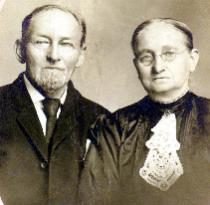
Letters from Sweden which Marylin had translated, reveal that Ingri came to the United States to marry Andrew. Whether she had known him prior to this is not known, however it would seem likely that she did. Ingri (her tombstone spells it Engri) arrived in Nebraska after, apparently, stopping along the way to visit acquaintances and, I suppose, explore the alternatives. Her family wrote to her encouraging her to honor her commitment and "join A. Thorson". From what we know of her today, taking charge of her own fate is quite consistent with the rest of her life. She was apparently a strong-willed woman with little tolerance for the foibles of others.
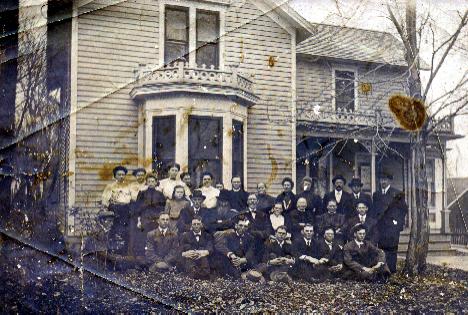
In one or two generations, the Thorsons on farms progressed from sharing a single little shack on the prairie to having substantial homes on prosperous farms. (Here is a picture of a bunch of Thorsons in front of one of those houses, don't know who, where or when.) It is that transition that has fascinated and frustrated what little research I have done to write this. The dilemma was solved upon reading My Antonia by Willa Cather. In that book she describes in sufficient detail life on the farms throughout the period of sod busting and into a period of prosperity. I highly recommend the book for anyone interested in their ancestors’ struggle in the new world. I learned, for example, that the sod busting went on for a number of years. I also learned that helpful, cooperative neighbors were essential and the four brothers must have had a substantial advantage.
The Thorsons on farms did not include Andrew and Ingri. My mother always said that they lost their farm due to a law suit over a dog bite, however the county records reveal that Ingri inherited the farm when Andrew died, long after they had moved into town. In fact, they did what many did: they found employment in and moved to town, and leased their land. The fact that the lessor had difficulty making payments (see county records) indicates that it was a wise choice. The other brothers increased their land holdings over time.
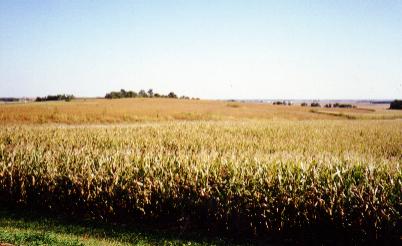
A recent (1996) visit to the farms revealed that, whereas Martin obtained bottom land in what became known as Todd Valley 2, Andrew’s land was the highest in the area and probably had neither the rich bottom land soil nor the water. It was not by accident that Martin was the most successful farmer and that his descendants farm that rich land today.
The railroad companies were the ever-present employers on the prairie for awhile, and the Thorsons moved into town and obtained jobs with the railroad as the managers of the railroad mess hall in Mead. The railroad workers ate a main meal at noon in the European tradition. According to Dorothy, this was provided to them by the railroad in what was known as "the Beanery." (I have learned to distrust her childhood memories as well as my own, and, I suppose, everyone else’s.)
Mead is a typical little agricultural town in the Midwest with a population of about 400. It was a shipping center for the crops raised on the farms and for importing the tools, machinery and supplies needed by the farmers. The whole town is probably not more than ten blocks wide. Downtown is a couple of blocks of stores, grain elevators and churches. I remember looking at pictures of either Mead or another nearby town such as Wahoo after it was devastated by tornadoes -- I think twice. In World War II a big ordnance plant was built in Mead, completely changing the economy for a few years, but it went right back to the way it had always been after the war.
The Andrew Thorsons remained in Mead until their deaths and raised two sons there. They had four sons, but Thore and George both died as young boys, Thore in infancy and George at 4 from diphtheria. Andrew, Ingri, Thore and George are buried in Alma Lutheran Cemetery about a mile west of Mead (as are John and Martin and their mates.)
Dorothy recalls many visits to her grandparents in Mead. She remembers that it was her grandmother, Ingri, who really ran the beanery with her grandfather running errands as directed. She remembers Ingri as being a somewhat severe person with high standards for her granddaughter which Dorothy failed to live up to. Most of all, she insisted that Dorothy should learn to speak Swedish. When this didn’t happen in Lincoln she asked to have her sent to Mead to attend the Alma Lutheran Church’s summer instructional program. Dorothy was a failure at it, though, and Ingri sent her home in disgust. This is, at least, her memory of the event. Dee Tejcka recalls that her father, Ingri’s nephew, also attended Swedish school at the church in the summers.
Dorothy always contrasted Ingri with her other grandmother, who she called her "happy grandmother." Ramona remembers her as short, rotund and with a thick Swedish accent. About Andrew Dorothy has few specific memories, other than that she mourned when his body was laid out in their living room in Lincoln (I don’t understand how this could have been, since I have seen the papers for probating his will and all funeral expenses were incurred in Mead. Those papers are in the Saunders County Courthouse in Wahoo.)
At this time her great uncles were the other Thorson brothers, several still on their farms. I have tried to spark her memory of them but she can’t help us. Neither could Alberta, who is about her age. Although Dorothy maintained contact with many of her cousins throughout her life, she didn’t seem to have a clear concept of exactly how they were related.
The two surviving sons of Andrew and Ingri were Karl Alexis and Christian Edwin. Karl was called Alexis by many in the family and, by the death of his father, signed papers as Charley A. Thorson. His brother remained Ed.
Name changing was common among
our Swedish ancestors. It is easy to understand since they were transitioning
between languages and cultures, but it seems to have continued beyond that
transition period. Of course, in Sweden those four immigrant brothers were
Thorssons because they were the sons of Thore. The next generation would
have been Johnsons, Carlsons, Andersons, and Martinsons. They broke that
tradition since that would not work in America. Then they Anglicized names,
such as Anders becoming Andrew and Karl becoming Charley. Dorothy was baptized
Dorothea Janet. Her name changed over time. By high school she had settled
on Dorothy Jean. Even my name was changed. On my birth certificate I am
Palmer McGrew. Shortly thereafter my parents added a II to the end. I dropped
that off as soon as I could, accidentally reverting to my given name.