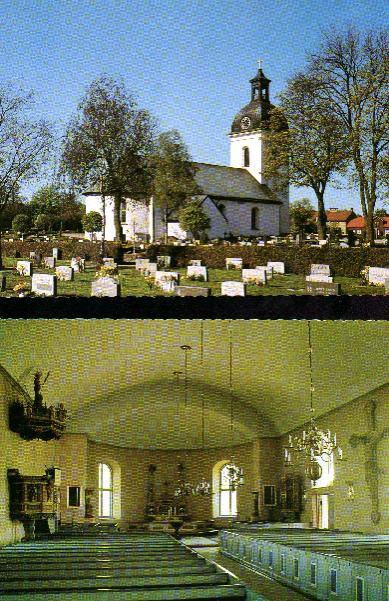
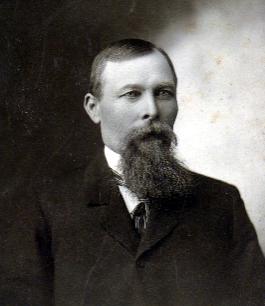
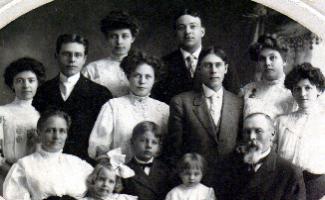
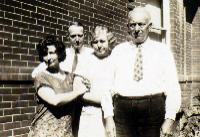
Hilda’s family is every bit as interesting as the Thorsons. In fact,in her generation, they were certainly more colorful. Her family emigrated to the United States after her birth, so that she and at least some of her siblings were born in Sweden. Although we know little of their life in Sweden, we know they came from the little town of Aseda (pronounced more like Oh-sheeda). Church in Aseda. He father, John Algot Anderson, as Hal noted, worked as a bricklayer or mason. They lived in Chicago prior to Omaha, but we know little of that. The family consisted of John Adolfson (who changed his name to Anderson for whatever reason); Vendla Caroline, his wife; sons Emil and Walter; and daughters Hilda, Jeanette and Esther. I was at Walter’s house on many occasions as a child. Emil and Jenny died without my knowing them. Esther I knew very well.
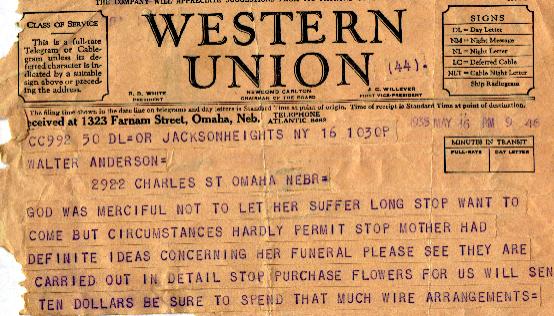
We have a scrap of a telegram from Esther and Jenny to Walter upon their mother’s death, and a series of letters written at that time between Esther, Jenny and Hilda. The telegram says: ...WANT TO COME BUT CIRCUMSTANCES HARDLY PERMIT STOP MOTHER HAD DEFINITE IDEAS ABOUT HER FUNERAL PLEASE SEE THEY ARE CARRIED OUT IN DETAIL STOP PURCHASE FLOWERS FOR US WILL SEND TEN DOLLARS BE SURE TO SPEND THAT MUCH... The crush of business preventing Esther from attending her mother’s funeral, the bossy tone of the telegram, and the obvious distrust of her brother (a successful businessman) are classic and probably give us insights into their relationship. In Esther’s letters to Hilda regarding disposition of her mother’s property she repeatedly accused Walter of stealing Emil’s pension money for years and insisted that he get not one thing from their mother’s estate. This was off base, I believe, because no one but Emil’s wife would have been eligible for the pension. Certainly not Walter. What had Walter done to deserve such treatment?
Esther, on one form, claimed not to know her former husband's birthdate and place. I don't know anything about her marriage(s), she never once mentioned anything about it (them) in my presence. One source shows her having married both George Johnson and Jim (James Barr) Henderson.
I first met Esther when she came to visit in Lincoln when I was about 6. She brought me a stamp book and stamps--she worked at the post office in New York City and had access to hordes of stamps. Later, when we lived in NYC, she would volunteer to take me out to dinner if my parents were busy. I had to meet her somewhere in Manhattan near her Wall Street office. She always wanted to take me to some fancy place but I preferred Nedicks hot dogs, or "franks" in NY parlance. No matter, she would gladly stand at the Nedicks stand with me munching a frank and sipping a big orange.
My favorite Esther story is about my sister-in-law's wedding in NYC. We all (Ceda and the kids) went to lunch with Esther at Schraft's (in the businessmen's --male only--section downstairs, because I was there). She asked if she could attend the wedding; she loved weddings. Well, sure, why not? So at the moment the bride was to start down the aisle, up pulls this long black limo and out steps Lady Esther, the legal secretary, swathed in mink and jewelry. She had a blast at the wedding as the mystery "rich lady" that nobody knew. She had no car and, in her 70s, was afraid to travel all over NY on the subway, so she hired William, a semiretired limo driver with his own older limo, to drive her to work or wherever, for $10 a trip.
She was still working on Wall Street in her 70s, having consistently lied about her age. When she turned 80 (maybe 78), she admitted to being 65 and retired. A whole collection of blond wigs helped her pull it off. In the late 40s she got caught up in the Arthur Murray dance lesson craze. Those turned out to be social clubs where you could continue to take "lessons" indefinitely, always striving to reach some higher level of proficiency. For many years she had a steady Wednesday night dance lesson and dance parties on other days. Through those she met a constant stream of bachelors and had "boy friends" for years.
She always worked for aspiring partners who worked overtime everyday and most weekends. In that way she accumulated a lot of money and kept herself busy. When one of them made partner, she would switch to a new aspirant. At the same time, she lived in a small rent-controlled flat in Flushing. The rent was ridiculously low, maybe $45 a month, and by law they couldn't raise it as long as she lived there. She lived there for some 30 years. So she had money to burn, way beyond her job level. Once she made presents to my kids of 6 toy banks, each a present from a bank for having an account with them. In those days the max insured was $10,000, so she had over $50,000 in the bank. Her stock account was always a subject of discussion, too, and I know she lost a bundle in the market at least once.
When she did retire, she bought a very nice condominium apartment in Clearwater, FL near my mom. She had been visiting her there for years. After she moved to Florida she became very much a part of Mom’s life. She eventually developed congestive heart failure and life slowly ebbed out of her. I have her photo albums and personal correspondence.
We know a fair amount about Emil (Dr Emil Anderson Lynwood, yes he changed his name!) because he was the family hero. He was a medical doctor who was called up and served overseas in World War I. After the War, and apparently before returning to the States, he traveled to Sweden and visited relatives and friends. He was known to them because he had been old enough before emigrating that people remembered him, and he was still fluent in Swedish. His long letter describing the trip is mandatory family reading. Marylin tried to duplicate his walking tour but couldn’t follow the landmarks ("...the wooden bridge...", for example) and wants to return to try again someday.
Even before the First World War, Emil was the apple of every niece’s eye. There are ample photographs to indicate that his portrait hung in many family parlors. Considered very handsome, he was quite the lady’s man. When he married Minnie (Wilhemina Selgren), she was a pretty, frail young woman, very dependent on Emil. We have letters from him to his parents describing his becoming ill, the loss of his strength, and eventual death from diabetes at a young age, 45. We believe that after his death, Minnie was confined to an institution for the rest of her life (by whom, why???) There were no children. He died long before I was born, but I can barely stand to read his letters from the hospital knowing what fate awaits him and Minnie.
Walter was a jeweler. His house was modest but nicely decorated and well maintained. His wife, Ida (sometimes spelled Idah), was very pleasant and kept a lovely home. Walter and Iva, however, seldom, if ever, visited anyone. If you wanted to see them you went there, and only after making a date a least a day in advance. Dorothy, the ever dutiful niece, visited them on virtually every trip to Omaha. They had two children, Bob and Marge. Bob was much like his father, a jeweler, quiet and reserved. Marge is a story unto herself. She married as a teen and quickly divorced ("a disastrous marriage"). Upon her divorce she entered her room and gave no indication of ever coming out. Only when her cousin Dorothy visited would she eventually come out. Sometimes we would sit around until late still waiting for her to emerge. Walter died in 1940, Iva in , and Bob in . Marge, then, was left alone. Staying in her room grieving or embarrassed was no longer viable. It seems that she then just resumed life as though nothing unusual had occurred for the past 40 years. Dorothy and others were surprised several years ago to learn that Marge had left her some $16,000 in her will. Where had she gotten that money? She owned the house, probably inherited some from her parents, and perhaps life insurance. Only recently I learned that her estate totaled nearly half a million dollars. She had become a patron of the symphony. She was rich.
Jenny (Janet Amelia or Jeanette) is one of my favorite family characters about whom I would love to know more. I believe that her life could be the basis of an interesting book if we knew more about it. She was reputed to be quite a beauty for her time. Actually, all the Anderson progeny were attractive people, but Jenny was considered the fairest of the fair.
The first I know of her was of her marriage to Julius Wolfe, a short, funny-looking Jewish salesman. Swedes marrying non-Swedes was a little radical in those times, and marrying Catholics was unthinkable. Imagine the furor over marrying a Jew. Julius’ work caused him to travel and move a lot, so he and Jenny lived all around the Midwest and passed through Lincoln and Omaha from time to time. Dorothy says that upon her birth the Wolffs showed up at Hilda and Charley’s house to take her (Dorothy) and raise her as their own. Their logic was that the Thorsons already had two children that they could barely afford and didn’t need a third, whereas the Wolffs had no children and lots of money. They would take Dorothy. Of course, they left empty handed.
What was going on between Jenny and Julius is not recorded, but we can surmise that it eventually turned ugly. We have good documentary evidence of Jenny hiding from her husband on Long Island, with her sister Esther (in NYC) as a co-conspirator. She was there by 1933 (age 50), perhaps earlier. She made the acquaintance of a man who was willing to share his name with her and act enough like a husband to prevent her having to disclose her actual identity. She therefore adopted the identity of Jeanette (Mrs Rodney) Ludlow. In letters to Esther she relates that Rodney would be in the City to sell jewelry (which supported her) or carry out some other transaction for her at certain times. It appears that the only rewards Rodney received for that sort of support were inexpensive presents on holidays. Esther was the bookkeeper and she kept very detailed records complete with receipts.
Jenny became ill in 1943, and was transported to a South Hampton hospital curiously named The Hospital for the Ruptured and Crippled. She was diagnosed as having a slight break in her hip. However, the correspondence seems to indicate that she continued to be in and out of the hospital for the rest of her life, a period of months. Whatever was causing her discomfort was probably never correctly diagnosed and the treatments she received at the hospital did nothing to cure her may even have been harmful. A small break would not have been fatal. She died at the age of 62. Julius apparently never found out where his wife was hiding and was probably not even notified of her death.
The Anderson offspring were a varied and colorful lot. The flamboyant Esther, dashing Emil, beautiful and star-crossed Jenny, hermit-like and possibly sinister Walter -- and the loving housewife, Hilda. There were few descendants from this group. Emil: no children. Walter: Bob and Marge, no further issue. Jenny: no children. Hilda: well, that is what the rest of this family history is all about.