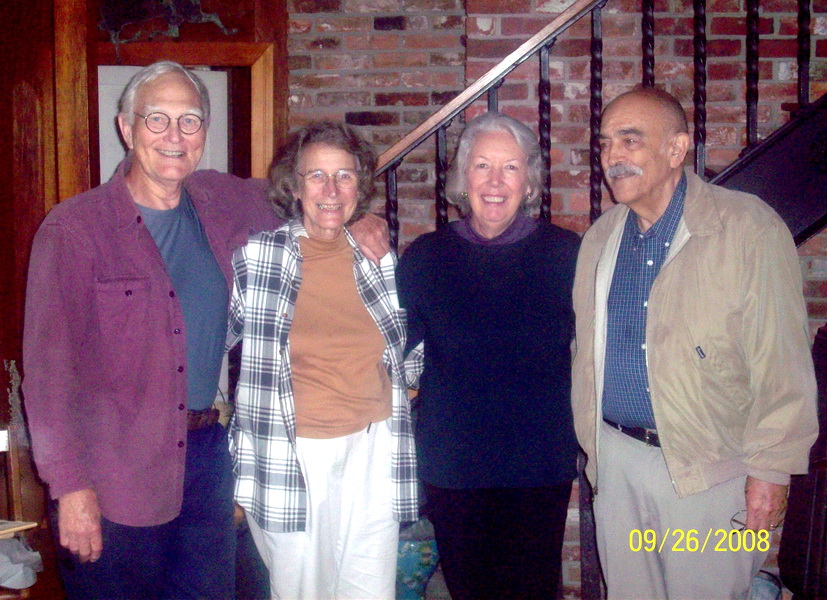
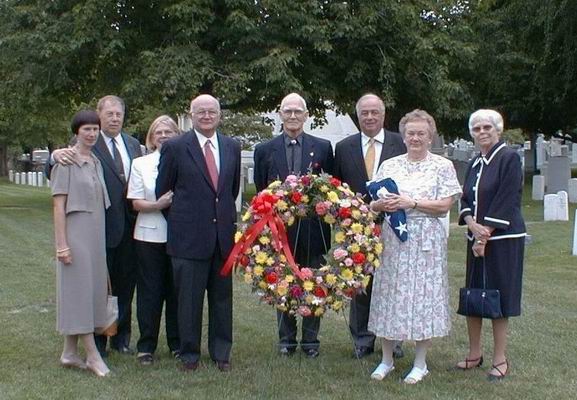
I-2 Wives
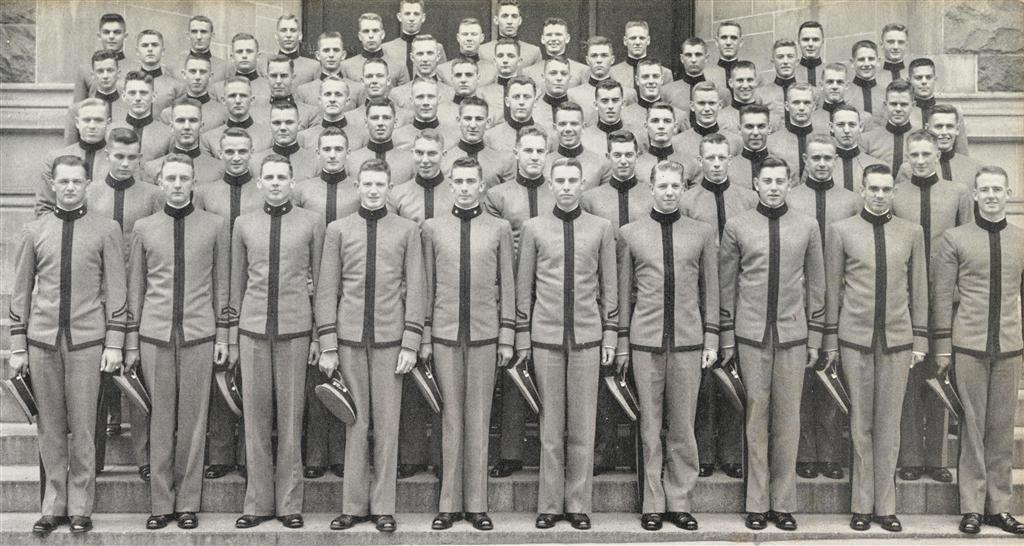
Plebe: Charlie Berg, Al Munsch, Chuck Roades, Bill Roth
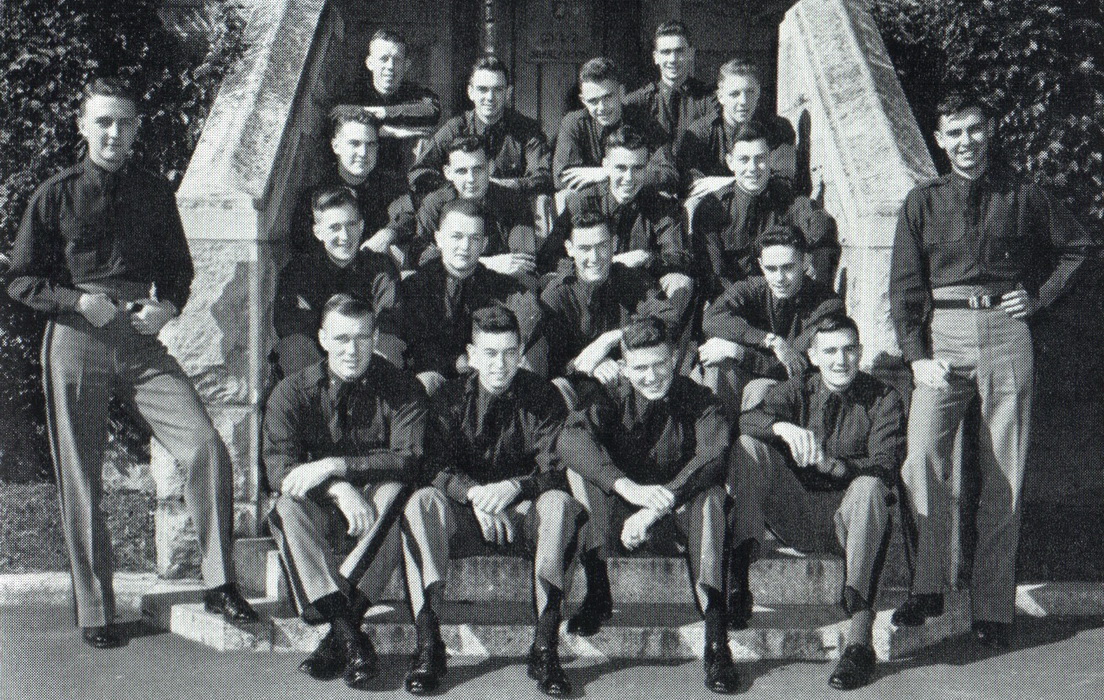
Yearling: Charlie Berg, Cliff Fralen, Chuck Roades
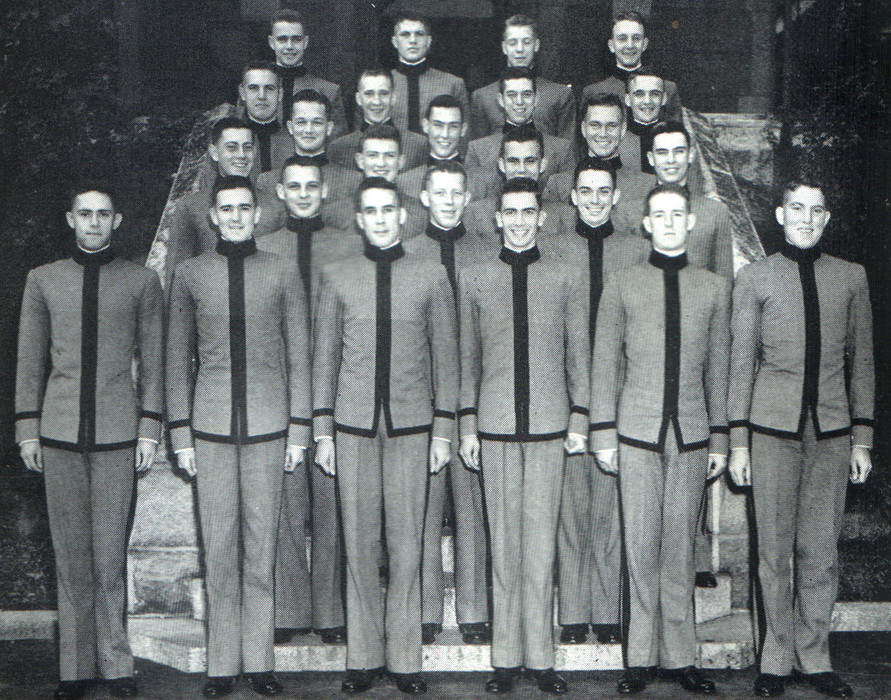
Cow: Charlie Berg, Dick Gray, John Hamilton
* * * * * * * * * * * * * * * * * * * * * *
How I got my appointment to West Point
As I have read the story of others in our class I have noticed that several of us have approached this story by reviewing their lives. I find that I must do that too.
My father served in WWI and in WWII, and the uncles on my mother's side of the family also served in WWII. (My other uncles were in Sweden.) Other than that, and having been at an impressionable age during WW II, I had no military influences in my upbringing. But our generation, I believe, came up feeling a tremendous debt of gratitude to - in fact awe of - those who fought the war. In my case that did not lead me to think of a military career, but I knew that military service was a highly honorable calling.
From early childhood I was fascinated by music and my earliest ambition was to become a performing musician. After a few bouts of piano lessens - not at all successful - I began to move around the country too frequently to settle into any systematic musical instruction. This was occasioned because my dad was at sea during the war, carrying aviation gas to where ever our troops needed it, and my mother and I moved to whatever port he might ship from. I satisfied my musical desires by playing piano and any other instrument I could lay hands on by ear.
Finally, in Philadelphia where our family settled in after the war, I took some instruction in playing the Tuba - 5th and 6th grade - and settled in to study of the Cello in Upper Darby Jr High. That instrument worked out pretty well for me, and I still have the Cello my parents gave me at the end of 7th grade. I played in the Swathmore Symphony college of the same name, as well as in the the Jr High orchestra and some other groups.
Our family had come out of WW I in somewhat reduced circumstances, and I saw education not only as my sole hope for any sort of advancement, but also as the best hope for exploring the questions with which live confronts us. My father and my mother believed in reading the way the Pope believes in Mass, and it all rubbed off on me.
My experiences in early schooling were not completely happy ones for me, despite the music that made up an important part of my life. Then, out of the blue, I was offered a full scholarship to play in the Valley Forge Military Academy Band. In those days the scholarships were especially generous: tuition, books, room, board, uniforms, under wear, shoes, and even better instruments for those who needed them. One could walk in naked, and appear in short time fully clothed and ready for duty. I took it, and took it fast. In Jr High, I had found it was not really socially respectable to study hard, or to play music seriously; I tried athletics, was middling in football, terrible in basketball, and even worse in track. So a change of scene with the possibility of developing some sort of future seemed a good idea.
At VFMA I Played Tuba, and the parts were challenging. We had a High School / Jr College concert band that took on anything from Tchaikovsky to Strauss, with some Gershwin on the side. Our day, in the Band, started with one of the trumpeters playing reveille, then 1st mess, then school until noon, at which time we played a parade, prior to 2d mess. Next was school, until 3:30, and then band practice at about 3:45 P M (God help any bandsman who was late without having the valid excuse of a freshly broken leg) and at about 5:45 we would break to play the parade for 3rd mess. After that, came study hall, and finally taps. I studied pretty hard and did pretty well academically.
In our senior year the band traveled to Kingston, O, Canada to play several concerts and parades for the Royal Military College cadets and staff. (RMC is the West Point Of Canada, actually closer to Sandhurst in that a fair number of cadets were college graduates before entering.) We had been given home work assignments and were expected to keep up with them in notebooks that could be inspected on our return. I don't know of anyone who took that seriously once we arrived at RMC. With the assistance of the local chapter of the Canadian Legion, we concentrated our off duty attention on Canadian Ale, a near approximation of mild explosive. That was the first time I had experienced double vision. My mind was not on academics.
Within the first 36 hours or so of our return to VFMA, we learned that our senior math P, Col. 'Bulldog' Snyder, USA ret., was inspecting homework note books. I was, at that time, hoping to graduate with good enough grades to win a college scholarship, and I knew that if the Bulldog saw my notebook my academic career was done. I had previously applied for an NROTC scholarship to Princeton, but I failed the physical for color blindness. I had earlier placed second place in a competition for a full scholarship at Princeton, and there was only one scholarship to be awarded. At the same 2d mess where we learned about Col. Snyder's intention to examine notebooks we also heard an announcement that the competitive exams for an Honor ROTC appointment to West Point would be held starting that afternoon and extending over the next day; moreover, any VFMA cadet who wished to take the exam but had not yet signed up for it could do so immediately and proceed to the exam room. In a flash, it became clear to me that I should consider a military career. I took that exam and came in first. Next I went to Ft Jay and took the regional exam for the Honor Military School ROTC appointment. On my way from Pennsylvania Station to the Battery Ferry dock, I stopped in many bars along my way and had at least one beer. One of them was the Glass Slipper where I heard, for the first and only time, Josh White in concert: dazzling. When I got to the island, I was very wobbly, and I questioned whether my adventurous soul had led me astray. Could I qualify in the regional exam? Mirabile Dictu, I was confident that the exam went alright.. There was a question about my physical exam, though. It was not color perception; the Army gave the AO color test which I can sort of pass, whereas the Navy used the Japanese test, which as most of you know is designed to expose color blindness, not just to test color perception. No, my physical had revealed that my urine was, well, strange: no wonder! So I stayed for a few days more and got tested several more times to see if the albumin that was first detected would disappear. It did, and I returned to Wayne PA to await what ever news the Army would send me.
God almighty! They gave me an appointment to USMA. So, with every one around me congratulating me on my appointment, and with my wondering what it would mean, I set about finishing my studies and prepared to set off for West Point.
I entered West Point with a lot of questions on my mind. But soon, despite engaging in the obligatory bitching about everything, I found that I really loved the place. I was immature; I thought that having been the salutatorian of a pretty good high school class I could take care of the academics with the same ease as before. WRONG! Of course, I had no idea in advance that the academic competition at West Point would be so tough. But that did not bother me; to meet that one just had to work hard. Moreover, I loved exercises in the field, and worried only that I was not good enough at it to become a leader of troops. Besides, where else in the world can one be a complete social rebel by wearing argyle socks or having a red satin lining sewn into ones tunic. (I did not do this, but a company mate did.)
To read that I loved West Point may surprise those who know me, because I did resign in mid Cow year to go to MIT. That is a completely different story, but I will not go into it here. I have said enough.
Charles A. Berg
30 AUG 2010
* * * * * * * * * * * * * * * * * * * * * *
My decision to leave West Point
When we entered West Point World War II was barely over and the Korean War had just begun. I have only recently realized how strongly these circumstances affected my own attitudes and, I think it fair to say, those of most members of my generation. A Time Magazine journalist with a cruel streak wrote, in the early 1960īs that ours was the 'silent generation.' I think we were the overwhelmed generation. I think we carried a debt of gratitude for all the people just a few years older than we who had to fight, suffer, and die to win the war. We were the beneficiaries. I was not driven to take up a military career by these circumstances; on the contrary, I wanted to go to Princeton and study History - to try to figure out what our times meant and what they might mean to future generations. But, there was no way for me to pay for Princeton. I was admitted, but without the one full scholarship that I had pinned all hope on. (I was informed by the scholarship board that I had placed second: great news, eh?) I was also admitted to MIT, but again with no scholarship.
We (the band) played a series of concerts in Canada - Kingston, Royal Military College, to be precise. When we returned I found that my math teacher, Col. USA, Ret. (Bulldog) Drummond was checking homework, with dire consequences for any delinquencies. Boy oh boy, was I delinquent after about a week on the road in Canada. Well, mirable dictu, at second mess that day there was an announcement that any cadet who had not signed up to take the first level competitive exam for an appointment to West Point could still do so and take the first round of the exam that afternoon. I signed up right away, and thus I got out the embarrassment of having Drummond find out abut my missing home work.
Now the strange thing about the whole situation was that I won the right to represent Valley Forge in the regional finals between Honor ROTC high schools for a real appointment to West Point. So, soon, I was off to New York City - Fort Jay on Governorīs Island, to be exact - where I competed in the final round of examinations. Somehow, I won. I really donīt know how. I just won. Now, having given almost not any thought to taking up a military career in earnest, I found that my successes in these competitions produced a wave of congratulations that propelled me toward West Point, as if destiny itself were calling.
Strange, Huh?
Once having entered West Point another strange thing occurred: I came to be a true believer. I could not have predicted - certainly I never expected - the degree to which I felt I had to commit myself to preparation for a military career. Anything less than full life commitment seemed to me, back then, unthinkable. My interpretation of why I should undertake this commitment to prepare may seem somewhat unorthodox. (I am not trying to be humorous here or in what follows; this is real.) I feared that at some time my physical courage might fail me, with the result that I might betray and destroy those for whom I was responsible. I began to test myself by subjecting my self to physical risk. I thought that if I could learn to estimate risks and to master my feelings in the face of risk I could become a good officer. Well, there was more than that. I knew I would never be satisfied with being a good officer. I wanted to be more than good - great if possible. Yes, yes, I know: all of this was youthful romanticism. But that is the point! I was a youth, and a romantic. (I might have been the US Armyīs own Beau Geste.)
As for risk, let me give you some examples. I once, on a dare, walked around the perimeter of a 6X6 truck, working my way along by toe holds and hand holds, out the back, around the body, across the front bumper, back down the other side, and then back into the rear compartment, all while the truck was moving down one of the roads at Buckner, at about 20 to 25 mph. I think I would have done it a 50 mph too. The point was that I had estimated the risk and was more than 95% sure that I could make it. I pulled off some operations, like smuggling beer into my company barracks during June week of my Yearling year and doing giant swings on the awaning in front of Eddie Condonīs: all just to test whether I could pull it off. I got my platoon leader drunk for parade - seriously so. I did all sorts of things just to test myself and to prepare myself for risk. I was serious.
Another thing I took seriously at West Point was athletics. I tried to learn how to play football. We in the all scholarship Band at Valley Forge were not allowed to play football: lip damage! I did play B Squad football at USMA, earnestly but not very well: but I learned and improved. I also took up wrestling in earnest. The fact is that I shortly became a very good wrestler, wrestling five matches for West Point as a freshman and winning them all by pins. (This is after the coach, Appleton, having seen my tryout match, told me that if I were a swimmer I might just make it across the pool.) Football was harder. For two years it was a mixture of dreams, boasts, and battering. Then, toward the end of my Yearling season, and into the first part of the season of my second class year I started to catch on how to play line backer. In fact, I was getting good - not A squad yet, but not bad for a guy who never played high school ball - and still with a lot of hopes.
Why this emphasis on athletics, especially the combative, contact sports. Well, you know the answer: 'On the fields of friendly strife . . . etc., ' I wanted to be a really good officer.
Finally I will add the most important element of the mental and emotional transformation that overtook me as a newly inducted cadet. I Believed!! Where the Academy Motto said Duty, Honor, Country, I believed every syllable.
In this program of preparation I had set out for myself, academic pursuits became somewhat less important - not secondary, but never as important as, say physical training or risk estimating.
Now enter some of the facts of life. In our second class year a plebe named Peterson appeared in my company. At first I thought his eccentric behavior was sort of like my own: a risk taker in training. Much too late I figured out that he was just a screw up!! For one reason or another, he got himself fixed up with a walking tour on the area and was, as a result, not permitted to join the Corps at the Army Navy Game. As was then the practice, the powers put him in the base hospital for the duration of the trip. While there, he apparently seduced a Nurse, and got caught in bed with her. They lowered the whole boom on him. My room mates and I thought the episode had its funny side, and given the sexual deprivation of the cadet life we even may have viewed him with a grudging envy. Now, I, at this time, had taken up playing the Bass Viol in place of my `cello or the tuba, and Peterson, who also played Bass Viol, would sometimes borrow my instrument. That was OK by me. When time came for the next big, short lived liberation of Plebes from West Point, Christmas. Peterson was still working off his slug and so was confined to the hospital once again. He asked if he could borrow my Bass while I was to be gone, and I said, 'Yes'. Now, here is where Peterson revealed his utter lack of brains as well as character: he did it again, and this time with a different nurse. (I donīt know why it is that some women are so strongly attracted to certain sure losers.) Well, by the time I got back from Christmas leave, Peterson was a former Cadet, and he had taken my Bass Viol with him. I was pretty vexed!! I donīt remember how I managed to get in touch with him, but I did: perhaps through one of his former room mates. Peterson said he couldnīt get the Bass back to me very quickly (my blood was boiling by now) but that he would offer to buy it. I considered my options: I had not been playing the Bass much in the past few months, and I know that my mother would be glad to get the money she had spent on it. The price he named was all right, and he offered to send a deposit of $75 to seal the bargain, with the rest to follow 'shortly' - in a week or two, supposedly. I agreed. He did send the down payment. Then, as time went on, he again became hard to find. I recall that he was supposed to meet me at the boat, one the pier at West Point, as we boarded to leave for summer training, there to give me the money he owed me: no show, of course.
I remember that summer: Eglin Air Force base, Fort Bragg, Monmouth in New Jersey, all the interesting stops. Well, at Fort Bragg I encountered my recently appointed tactical officer, Lt. Colonel Timothy (recently promoted.) I somehow wound up dating a daughter of a colonel on the base, and we went to the officerīs club to swim. On the apron of the pool I found Col. Timothy, looking in top shape from his course of jump training. He was sitting in a reclining chair, drinking something that looked like Scotch and ice. Naturally, he greeted me and asked me how things were going. I said all was well (I thought it was!). However, I did mention that I had a problem that presented me with difficulty. 'What is it,' he said, and off we went. When I had fully explained the Peterson matter to him, he said, as best I can recall (I have pretty good recall, by the way) 'I donīt see what the problem is. You a bigger and stronger than Peterson; you play football. Just go to his house and take the Bass.' Like a damned fool, I took his advice. Well, actually, it took me a lot of trouble to find Petersonīs abode. I finally ran him down through news paper clippings, former employers, etc. At one stop, I found his in laws. There house was full of small children under the supervision of a woman who seemed not to speak English: maybe Spanish, but she mumbled a lot. I asked if a Bass viol were in the house, and I got no answer. Jack Farrington and a girl named Shirley Price were looking on from Shirleyīs car at the curb. I asked whether I could look inside the house. The woman stepped aside and I entered. That was fatally stupid, I know, but I did it. The Bass was not there. However, I did finally find where Peterson and his new wife were living; we went there. I demanded the Bass, and took possession of it. From there , just outside of Highland Falls, it was a very expensive cab trip to New York City, where I met Judy (my wife) for an evening of dinner, a few of those innocently intimate moments of 1950īs style affection, and then a wild taxi trip to catch the `plane to Houston, at the old Newark airport. I thought I had Peterson and the problem of the Bass out of my hair, and could get on with things. I expected to settle up with him for the advance he paid me, when I got back. But frankly, I did not intend to hurry about the matter. Given the expense and trouble he had put me to I thought it could be his turn to wait a while. Besides it was a matter of civil law, and I intended to ask an attorney who had worked for our family about the matter.
Now, when I returned to West Point - I mean that very afternoon - I was presented with a statement of charges that I was to answer in a regimental board, the very next day. My memory of the time between my setting foot on the reservation and the convening of the board is a blur. I read the charges: they consisted of a statement by the woman who admitted me (I thought she had admitted me) to Petersonīs in-lawīs house, along with affidavits sworn by her employers, the in-laws themselves, that I had forced my way into the house and abused everyone in sight. Incidentally, the in laws were not present when I was there. I know that if I could get Shirley Price to West Point as a witness, I might defeat this pack of lies. Also I had hoped that Jack Farrington could testify. I donīt recall. He may have. What ever the case, on the next day, about mid afternoon as I recall, I found myself facing a regimental board. The Chairman was a full bird colonel whom I did not know. In fact I did not know anyone else on that board, except for the secretary - my tactical officer, Col. Timothy. I told my story to the Board and tried to answer their questions. The Chairman, after listening, then asked me 'what about the $75 dollars Peterson paid as a down payment on the Bass.' Well, I said, I was not sure what to do about that. I had wanted to explain that I had had to under take substantial expense in recovering the Bass because of Petersonīs devious behavior. I mentioned that the Peterson had use the Bass to earn money and that rental on a Bass for the time he had had it would have eaten up much of a $75 deposit. I got no farther: the bird flew!! That colonel, silver eagles and all, came straight up from his chair, roaring, 'Mr. Berg, Youīre not here to rent musical instruments, youīre here to become an officer!' My goose was cooked. Several of the officer members of the board had commented on the proceeding as it went along, and some of them did not seem ill disposed to me. The one who said absolutely nothing was my TAC. - Col, Timothy. I played the part of the good soldier, as I saw it. I kept my mouth shut about any advice I might have gotten from anyone about how to handle the Peterson affair.
It takes a while for a board to publish its findings. During this time, I continued to play football, although I know the probability of my staying on the team was remote. The game itself went very well. The A squad Coach's were calling me more and more to scrimmage with the team, and I felt I was accomplishing something important, something I had set out to do as part of my preparation for the Army.
Then the verdict arrived. I was guilty not of breaking into a house and abusing anyone, not of any of the things that appeared in the statement of charges against me: I was guilty of bring discredit on the Corps by associating with unsavory persons (Peterson, in the case). I was outraged. The fact was that the Corps had introduced this unsavory Peterson to me in the first place. I was also outraged about the behavior of Col. Timothy; he knew the entire story but kept his mouth shut during the board - not even a, 'Mr President, may we go into executive session?' His assets were good and securely covered. So, I got a screwing, at least I thought so (and still do). But the screwing is not why I resigned. My faith in the whole concept of 'Duty, Honor, Country' was destroyed - by the pusillanimous behavior of my tactical officer: the man who, as I saw it, advised me how to do a job _and when the job went wrong just ducked into the shadows. I lost my desire to be a part of the Army. Once, on parade, Col. Timothy came up to me and said in a voice to low to be heard by even those next to me, 'Iīm sorry about this, Mr. Berg.' I responded in a bellow, 'Yes Sir!!': `could have gotten my tail in another crack I guess. On another occasion, when I was walking off my six months (the cover charge at regimental boards), an officer, I think a Colonel (full), walked straight up to me and asked, What do you think of your punishment Mr. Berg? Now, just before my board, Willie Wyman, one of our class mates and the son of a high ranking general in NATO, had been shot by a NY bar keep in a fracas over a woman, the bar keepīs wife as I recall. I believed that my board had been rushed through to prevent another West Point scandal from getting into the papers. And so, I answered, 'Sir, I believe it is the greatest prostitution of justice to the means of public relations that I shall ever hope to witness.' He smiled, slightly.
One other note belongs here. Shortly after my board I finally got to see the Judge Advocate at West Point. He told me that he regretted that no one had brought my case to his attention, and that no one had suggested to me to do so before the board was to meet. I learned that my Tac was responsible to advise me on that matter; that would have been a miracle. But JAG told me that I had had a right to counsel at that board and that I also had a right to prepare a defense with counsel prior to the trial. As for the matter of Petersonīs $75 he said that on all such questions, i.e., those not having to do directly with the charges, one should simply have said that one must seek advice of civil counsel.
(Jack Farington remarked, when he and Bev came to visit us in Maine, that if someone defaults on a contract, he forfeits any down payment: according to Jack, this was taught even in the West Point survey course on law. Besides, Jack said, he and Shirley Price would have been eager to testify that I had not abused anyone on our visit to Peterson's wife's household.)
Well, I applied for readmission to MIT, and they let me in. My parents agreed to pay for the rest of undergraduate training there, and I earned the rest of the money required for grad schooling myself. Queen Federika of Greece came to West Point, and gave every one on the area amnesty. I had been determined to walk off the whole damned punishment, even if I could not enter MIT until the next fall term. But thanks to the good queen, I was able to submit my resignation in January and enter MIT in February, 1954.
Now, that is the first chapter. For me the story has kept unfolding over the years. First, I was wrong! My disappointment in West Point in no way meant that West Point itself was any less valid than I had thought prior to the incident I have related. Col Timothy was just a weak man, one who could not, then, stand up to the stress of his own personal circumstances. I feel even sorry for him and the life he then lived. I forgive him, and I have prayed for his soul, in addition to the souls of others for whom I regularly pray. In addition, I was, in fact am, also a bipolar depressive, and I was developing some of the more debilitating aspects of the condition at just about the time this all happened. This is not a state of mind in which to make critical decisions. I will not go here into the chapters of this story that followed this episode, only to say that I have spent many a night in dreams about my decision to leave. Well, there it is, warts and all.
Charles A. Berg
12 Jun 2010
|